Neck Pain Chiropractor in Santa Ana: Treating Tech Neck, Text Neck & Cervical Pain

- What Is Tech Neck and Why Is It So Common?
- What Are the Symptoms of Tech Neck and Text Neck?
- How Does Forward Head Posture Affect Your Cervical Spine?
- Who Is Most at Risk for Tech Neck in Santa Ana?
- How Does Chiropractic Care Address Tech Neck and Cervical Pain?
- What Chiropractic Techniques Are Used for Cervical Spine Pain Relief?
- What Role Does Posture Correction Play in Long-Term Neck Pain Relief?
- How Has Remote Work and Screen Time Fueled the Tech Neck Epidemic?
- What Can You Do at Home to Support Cervical Spine Health?
- When Should You Seek Professional Help for Neck Pain?
- Frequently Asked Questions
- About One & Only Chiropractic
- References
What Is Tech Neck and Why Is It So Common?
If you have ever caught yourself hunching over your phone or craning your neck toward a computer monitor, you already know the feeling that comes with it: a dull ache at the base of your skull, tightness across the upper back, and a creeping stiffness that seems to settle in by midafternoon. That pattern of discomfort has a name: tech neck. It is also called text neck, and it describes the postural strain that builds up when you tilt your head forward repeatedly or for extended periods while using digital devices.
The condition is not a new injury in the traditional sense. There is no single moment of trauma. Instead, it develops gradually through accumulated stress on the cervical spine, which is the seven-vertebra section of your spine that runs through your neck. When your head drifts forward of your center of gravity, the weight your spine must support increases significantly. Research published in Surgical Technology International calculated that a head tilted just 15 degrees forward effectively places about 27 pounds of force on the cervical spine. At 30 degrees, that figure rises to approximately 40 pounds, and at 60 degrees, it approaches 60 pounds of effective gravitational load, compared to the roughly 10 to 12 pounds the spine supports when the head is in a neutral position. [1]
Here’s where it gets interesting. Most people seriously underestimate how much time they spend looking down or leaning forward at a screen. Phones alone? Several hours a day for the average American, give or take. Then you add the laptop, the tablet, maybe an hour of TV before bed. That’s a lot of postural strain stacking up. And bodies, even pretty resilient ones, can only soak up so much of that before something starts to give.
Here in Santa Ana, this is showing up everywhere. It’s an office town, a remote work town, a college town, and after COVID flipped everyone’s routines upside down, that mix just got messier. The result? Chiropractic offices across Santa Ana and greater Orange County are seeing more and more younger adults walk in. Twenties, thirties, forties. No big injury behind it. Just chronic, low-grade neck and upper back tension that’s wearing them down at work and at home.
What Are the Symptoms of Tech Neck and Text Neck?
Tech neck and text neck do not always announce themselves loudly. For many people, the symptoms begin subtly and escalate over time. Understanding what to look for can help you recognize the pattern before it worsens.
- Neck stiffness and soreness that tends to be worse after prolonged device use or screen time, often concentrated at the base of the skull or along the sides of the neck.
- Upper back and shoulder tension that feels like chronic tightness across the trapezius and upper shoulder area, sometimes described as a constant sense of carrying weight.
- Headaches that originate at the back of the head or the base of the skull and radiate forward, sometimes classified as cervicogenic headaches because they stem from the cervical spine rather than the brain itself.
- Arm and hand tingling or numbness that can occur when nerve roots in the cervical spine are compressed or irritated by postural changes.
- Reduced range of motion in turning or tilting the head, which may be accompanied by clicking, grinding, or popping sounds in the neck.
- Forward head posture that becomes visible in photographs or mirrors, where the ear is noticeably in front of the shoulder rather than aligned over it.
- Fatigue and eye strain that often accompany prolonged screen use and are compounded by the muscle effort required to hold the head in a forward position.
If several of these symptoms sound familiar, you are not alone. Neck pain is among the most common musculoskeletal complaints encountered in clinical settings, and its relationship to screen-based work and device use is well established in the research literature. [2]
How Does Forward Head Posture Affect Your Cervical Spine?
Tech neck makes more sense once you know what your neck is actually doing in there. The cervical spine has this gentle C-curve, a lordosis, and it’s not just decorative. That shape is how the spine absorbs force and spreads it around without overloading any single spot. Head stacked over the shoulders, everything balanced, and the muscles, ligaments, and discs handle the load like they’re supposed to. That’s the baseline. Mess with that alignment and things start going sideways pretty quickly.
Forward head posture throws the whole thing off. The curve flattens, sometimes it reverses, and suddenly the muscles at the back of your neck are working overtime. We’re talking the suboccipitals, semispinalis, upper trapezius. They’re contracting nonstop trying to keep your head from drifting any further forward. That’s exhausting, and they let you know about it. At the same time? The muscles in the front of your neck, including the deep cervical flexors, kind of go to sleep. Underused. Weak. That mismatch changes how each vertebra moves on the next one, and given enough time, you start seeing restricted motion, nerve irritation, the whole disc-stress story.
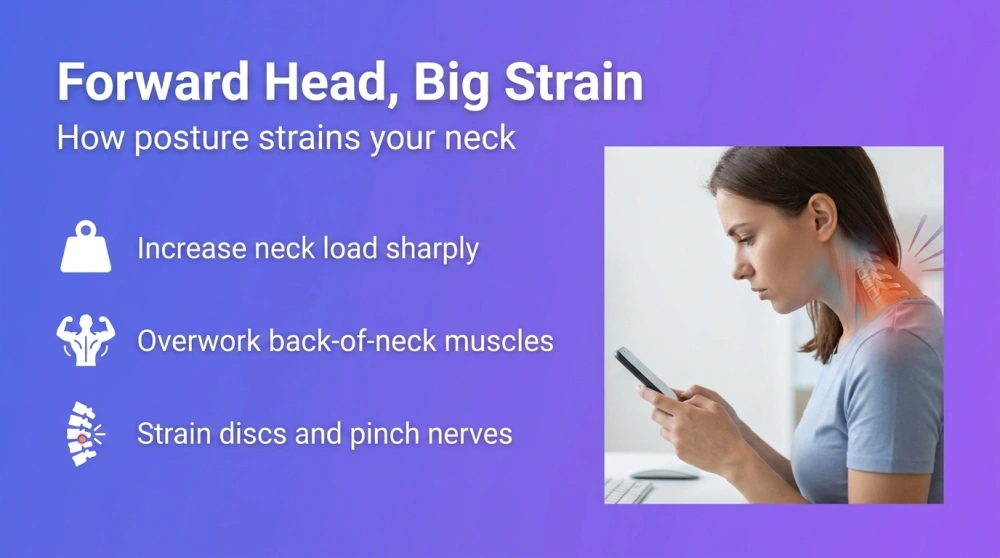
Now think about the discs. Those intervertebral cushions between your vertebrae are doing serious work, and forward head posture cranks up the compressive forces they have to deal with. Sustained, abnormal loading like that? It can accelerate the degenerative changes that show up on imaging years before they probably should. And the ligaments and tendons around the cervical spine aren’t off the hook either. They can get overstretched from holding things together under load, which kind of slowly undermines the structural integrity of the whole neck. [3]
And the nerves are part of this too, which is the part that surprises people. The nerve roots leaving your cervical spine head straight into the arms and hands, all the way down to your fingertips. When joints get cranky or disc changes shrink the spaces those nerves have to pass through, you start getting weird stuff. Tingling. Numbness. Maybe even a grip that just feels off. Doctors call this cervical radiculopathy, and honestly, it’s one of the bigger reasons that brushing off chronic posture pain as no big deal is kind of a mistake.
Who Is Most at Risk for Tech Neck in Santa Ana?
While tech neck can affect virtually anyone who uses digital devices, certain populations tend to experience it more acutely. In Santa Ana and surrounding Orange County communities, the following groups are among those most commonly seeking chiropractic care for neck pain chiropractor Santa Ana services:
- Remote workers and telecommuters who have converted kitchens, bedrooms, and living rooms into workspaces, often without the ergonomic setups their offices provided.
- Office workers who spend six to nine or more hours per day in front of computer screens, frequently in chairs and at desk heights that encourage slumping or forward leaning.
- College and high school students who use laptops and tablets extensively for coursework and are simultaneously heavy smartphone users in their personal time.
- Healthcare professionals, retail workers, and others in occupations that involve looking downward or forward for sustained periods.
- Gamers and streamers who engage in extended sessions in front of screens, often in postures that strain the cervical and upper thoracic spine.
- Smartphone users of all ages who scroll social media, watch video content, and communicate by text for cumulative hours each day.
The age range most affected tends to cluster between 25 and 55, though younger users are increasingly presenting with symptoms. The rise of remote work in the wake of the COVID-19 pandemic has dramatically accelerated the timeline for many people who might otherwise have developed symptoms more gradually.
How Does Chiropractic Care Address Tech Neck and Cervical Pain?
Chiropractic care for neck pain focuses on identifying and addressing the underlying structural and functional causes of discomfort rather than simply managing symptoms. A licensed chiropractor performing chiropractic care for neck pain will typically begin with a thorough evaluation that includes a health history, postural assessment, orthopedic and neurological testing, and often imaging such as X-rays where clinically indicated.
The goal of this evaluation is to understand where the cervical spine is not moving as it should, which muscles are imbalanced, and whether nerve involvement is present. This picture then guides a personalized care plan that may include hands-on treatment, rehabilitative guidance, and education about postural habits and ergonomics.
Chiropractic adjustments, also called spinal manipulations, are one of the primary tools used to restore normal joint motion in the cervical spine. When individual vertebrae become restricted in their movement, the tissues around them can become irritated and painful. A controlled, targeted adjustment applies a specific force to the restricted segment to restore mobility and reduce associated muscle guarding and inflammation.
Research has examined the role of spinal manipulation in managing neck pain, and the American Chiropractic Association has noted that evidence supports manual therapies as part of a comprehensive approach to cervical pain management. [4] Importantly, chiropractic care approaches the neck as part of an integrated musculoskeletal system, recognizing that posture, thoracic mobility, core stability, and hip alignment all influence cervical spine mechanics.
What Chiropractic Techniques Are Used for Cervical Spine Pain Relief?
Chiropractors draw on a range of techniques depending on the patient’s individual presentation, preferences, and clinical needs. No single approach works identically for every person, and a quality practice will adapt its methods accordingly.
- Cervical manipulation involves precise, low-amplitude thrusts to individual neck joints to restore motion and reduce pain. Multiple systematic reviews have examined its application for acute and subacute neck pain.
- Cervical mobilization uses slower, oscillatory movements within and at the limits of joint range of motion, offering a gentler alternative for patients who prefer or require a less forceful approach.
- Soft tissue therapies including myofascial release, trigger point therapy, and instrument-assisted techniques address muscular tightness, adhesions, and chronic tension in the upper back and neck.
- Traction or decompression gently elongates the cervical spine to reduce pressure on discs and nerve roots, which may be particularly relevant for patients with radiating arm symptoms.
- Rehabilitative exercises prescribed by the chiropractor target the deep cervical flexors, scapular stabilizers, and thoracic extensors to address the muscular imbalances underlying forward head posture.
- Postural retraining and ergonomic counseling help patients understand how their workstation setup, sleeping position, and daily movement patterns contribute to their symptoms and what adjustments can reduce that load over time.
The combination of hands-on care with active patient participation in rehabilitative exercises tends to produce more durable outcomes than passive treatment alone. Patients who engage with the movement and lifestyle guidance their chiropractor provides generally report improvements that persist beyond their active care period.
What Role Does Posture Correction Play in Long-Term Neck Pain Relief?
Forward head posture treatment is one of the most clinically meaningful aspects of addressing tech neck because even the most effective in-office care will have limited long-term benefit if the underlying postural habits that created the problem continue unchanged. Think of it this way: if you are spending eight hours per day in a posture that strains your cervical spine, one hour of chiropractic treatment cannot fully counteract that.
Forward head posture treatment typically involves a multi-step process. First, joint function is restored through chiropractic adjustments or mobilization so the spine can move through its appropriate range of motion. Second, muscle imbalances are addressed through targeted exercise, releasing overactive muscles and strengthening underactive ones. Third, neuromuscular habits are retrained so that the body begins to default toward a healthier resting posture over time.
Research published in peer-reviewed journals has explored how chin tuck exercises, thoracic extension drills, and scapular retraction work can collectively reduce forward head posture measurements and associated symptoms. [5] These exercises are not complicated, but they do require consistency. A chiropractor can teach you the correct form and help you integrate them into a practical daily routine.
Ergonomic adjustments also play a significant role. Raising a computer monitor to eye level, adjusting desk and chair heights so the forearms rest comfortably without shoulder elevation, and using a phone or tablet holder that keeps screens at a higher angle all reduce the degree of cervical flexion required throughout the day. Small changes in the environment can translate meaningfully into reduced symptom burden over time.
How Has Remote Work and Screen Time Fueled the Tech Neck Epidemic?
The shift to widespread remote and hybrid work that accelerated during the COVID-19 pandemic introduced millions of people to makeshift home office setups that varied dramatically in ergonomic quality. Kitchen tables and sofas replaced purpose-designed workstations, laptops replaced desktop monitors with proper screen height, and video conference fatigue added hours of screen time on top of already significant daily device use.
The timing correlates with a notable uptick in patients presenting to chiropractic offices with tech neck and cervical pain complaints. Workplace musculoskeletal disorders, including neck and upper back conditions, have long been recognized as a significant source of work-related injury and productivity loss. The Bureau of Labor Statistics has historically reported musculoskeletal disorders as a major category of workplace injury, accounting for a substantial share of lost workdays annually. [6]
In California particularly, where tech industries, healthcare, education, and service sectors all have large remote and hybrid workforces, the intersection of device dependence and ergonomic inadequacy has created fertile conditions for tech neck to thrive. Santa Ana sits at the heart of Orange County, a region with a significant white-collar workforce, and the pattern of screen-related cervical complaints reflects broader national and state trends.
Children and adolescents are not immune either. Pediatric and adolescent smartphone use continues to grow, and young spines that are still developing are potentially vulnerable to structural changes from sustained postural loading. While this article focuses primarily on the adult population, parents should be aware that posture habits formed early have long-term implications.
What Can You Do at Home to Support Cervical Spine Health?
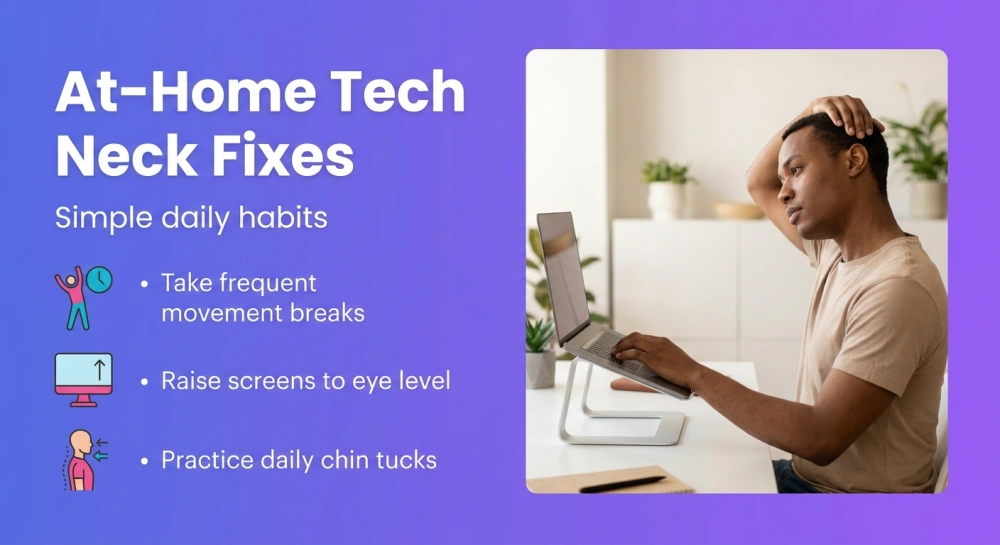
Professional chiropractic care addresses structural dysfunction in ways that self-care alone cannot replicate, but there is meaningful value in the habits you maintain between appointments and as part of your everyday routine. The following steps are generally supported by clinical guidance for people managing or trying to prevent cervicogenic pain.
- Set device reminders and take movement breaks every 30 to 45 minutes during extended screen sessions to stand, stretch the neck gently, and reset your posture.
- Practice chin tucks regularly by gently drawing the chin back to create a double-chin appearance, which activates the deep cervical flexors and counteracts the forward head drift. Hold briefly and repeat throughout the day.
- Elevate your phone and screens to bring them closer to eye level, reducing the degree of forward flexion required to see the screen comfortably.
- Strengthen your mid-back and scapular muscles through exercises like wall angels, resistance band rows, and prone extensions, which support upright posture by addressing thoracic weakness.
- Evaluate your sleep posture and pillow support, ensuring your neck is in a neutral position when lying down rather than propped forward or dropped to one side.
- Stay hydrated since the intervertebral discs are largely composed of water and require adequate hydration to maintain height and shock-absorbing capacity.
- Perform gentle neck mobility work within a pain-free range, including slow rotation and lateral flexion, to maintain the movement your cervical joints need to stay healthy.
These strategies are supportive, not curative. If you are already experiencing significant pain, restricted motion, headaches, or arm symptoms, self-care should complement professional evaluation rather than replace it.
When Should You Seek Professional Help for Neck Pain?
Many people tolerate neck discomfort for longer than they should, attributing it to stress, poor sleep, or simply the price of a busy life. Certain patterns warrant prompt professional attention from a qualified clinician.
You should consider seeking evaluation from a neck pain chiropractor Santa Ana provider if your symptoms include any of the following:
- Neck pain that has persisted for more than two to three weeks without meaningful improvement despite rest, heat, or over-the-counter pain relief.
- Pain that radiates down the arm, particularly if accompanied by tingling, numbness, or weakness in the hand or fingers.
- Headaches that occur frequently and seem to originate in the neck or base of the skull.
- Significant restriction in neck movement that interferes with driving, working, or daily activities.
- Neck pain following an accident, fall, or sports injury, even if it seems mild at first.
- Dizziness, balance issues, or visual disturbances alongside neck pain, which warrant prompt evaluation to rule out vascular or neurological causes.
A chiropractic evaluation can help determine the nature and extent of your cervical spine issue, whether chiropractic care is appropriate for your situation, and whether referral to another specialist is warranted. Many chiropractors work collaboratively with primary care physicians, physical therapists, and other healthcare providers to coordinate care when needed.
Frequently Asked Questions
How long does it typically take to see improvement with chiropractic care for tech neck?
This varies considerably depending on how long the condition has been present, its severity, and how consistently you engage with the recommended care and home exercises. Many patients notice some improvement in pain and mobility within several sessions, while postural changes and more lasting relief typically develop over weeks to months of care. Chronic conditions that have been present for years generally require more time than those caught early.
Is chiropractic adjustment to the neck safe?
Cervical manipulation is a widely practiced intervention with a well-documented safety profile when performed by a trained and licensed chiropractor following an appropriate clinical evaluation. As with any healthcare intervention, potential benefits and risks vary by individual and should be discussed openly with your provider. Your chiropractor will conduct a thorough assessment before recommending treatment and can discuss gentler alternatives if standard manipulation is not appropriate for your situation.
Can tech neck cause permanent damage if left untreated?
Prolonged, unaddressed forward head posture and associated cervical dysfunction can contribute to accelerated degenerative changes in the discs and joints of the neck over time. This does not mean every case of tech neck will lead to serious long-term consequences, but ignoring persistent symptoms reduces the opportunity to address postural and structural factors before they become more entrenched. Early intervention is generally associated with more favorable outcomes.
Can children and teenagers develop tech neck?
Yes. Younger individuals who use smartphones, tablets, and laptops extensively can develop the same postural strain patterns as adults. Because spines are still developing during adolescence, the window for establishing healthy habits and addressing postural issues early is particularly valuable. Parents who notice their children consistently holding devices with their head dropped forward may want to raise the issue with a health professional.
Will I need X-rays before receiving chiropractic care for neck pain?
Not necessarily. Whether X-rays are recommended depends on your clinical presentation, history, and the chiropractor’s assessment. Imaging can be useful when there is concern about fracture, significant degenerative change, instability, or other findings that would influence the approach to care. Your chiropractor will discuss whether imaging is indicated based on your individual circumstances.
How is text neck different from a neck sprain or strain from an accident?
A neck sprain or strain from an accident involves acute tissue injury that typically has a sudden onset linked to a specific traumatic event such as a car collision or a sports injury. Text neck, by contrast, develops as a cumulative overuse and postural strain pattern over weeks, months, or years without a single precipitating event. The underlying tissues involved may overlap, but the mechanisms of injury and the typical timelines for recovery differ. Both conditions can respond well to chiropractic care, though the specific approach may vary.
About One & Only Chiropractic
One & Only Chiropractic serves patients in Santa Ana, California, and the surrounding Orange County region as a wellness and injury clinic focused on delivering personalized, evidence-based chiropractic care. The clinic was established with a clear mission: to address pain and injury at their root while supporting long-term vitality, mobility, and quality of life through minimally invasive, patient-centered treatment.
If you are living with tech neck, text neck, or cervical spine pain in Santa Ana, our team understands the real-world demands that create these conditions. We work with remote workers, office professionals, students, and active individuals who need care that fits into their lives and addresses the structural factors driving their discomfort. Our approach integrates spinal adjustments, soft tissue therapies, corrective exercise guidance, and ergonomic education so that you leave each visit with both symptom relief and actionable tools for long-term improvement.
One & Only Chiropractic is committed to seeing patients of all ages, from pediatric and prenatal care through adult wellness and post-injury rehabilitation. Every care plan is tailored to the individual, with direct access to qualified professionals who take the time to understand your history, goals, and concerns. We do not operate on a one-size-fits-all model because the people we serve are not one-size-fits-all.
We serve patients throughout Santa Ana and the greater Orange County area, including patients searching for tech neck chiropractor Orange County care that combines clinical depth with a genuinely personal approach. Whether you are just beginning to notice neck tension from your workday or have been dealing with chronic cervical pain for years, we welcome the opportunity to evaluate your situation and discuss how we may be able to help.
Working from home and dealing with neck pain? Our Santa Ana chiropractors can help. Book an evaluation online or call us at (949) 800-8525 to take the first step toward addressing your cervical spine health.
References
- Hansraj KK. Assessment of stresses in the cervical spine caused by posture and position of the head. Surg Technol Int. 2014 Nov;25:277-9 – PubMed, National Library of Medicine
- What Research Shows – American Chiropractic Association
- Cervical Spondylosis – StatPearls, National Library of Medicine, NIH
- Chiropractic Care Information for Patients – American Chiropractic Association
- Kim EK, Kim JS. Correlation between rounded shoulder posture, neck disability indices, and degree of forward head posture. J Phys Ther Sci. 2016;28(10):2929-2932 – PubMed, National Library of Medicine
- Occupational Injuries and Illnesses, Case and Demographic Data – Bureau of Labor Statistics, U.S. Department of Labor
- Ergonomics and Musculoskeletal Disorders – National Institute for Occupational Safety and Health (NIOSH), CDC
- Kazeminasab S, et al. Neck pain: global epidemiology, trends and risk factors. BMC Musculoskelet Disord. 2022;23(1):26 – PubMed, National Library of Medicine
- Neck Pain Patient Education – North American Spine Society
- National Institute for Occupational Safety and Health – Centers for Disease Control and Prevention
About the Author