“Migraine Relief Without Medication: How Chiropractic Care Helps Orange County Residents”
- What makes migraines different from other headaches?
- Why consider migraine relief without medication in Santa Ana?
- What does current research say about chiropractic care for migraines?
- How can spinal assessment and gentle adjustments influence migraine pathways?
- Which migraine triggers can chiropractic teams help you identify and manage?
- How are tension headaches and neck pain connected to migraine patterns?
- What should you expect during a first visit at an Orange County chiropractic clinic?
- Is chiropractic migraine care safe and who is not a good candidate?
- What self care steps support drug free headache relief between visits?
- How do California rules guide chiropractic care for migraine?
- What other questions do Santa Ana patients often ask about chiropractic care for migraines?
- How does OneAndOnlyChiro serve Santa Ana residents seeking migraine relief without medication?
- Where can you find the references used in this article?
What makes migraines different from other headaches?
If you live in Santa Ana or anywhere in Orange County and you deal with headaches that stop you in your tracks, you might wonder whether they are migraines. Migraines are more than a bad headache. They are a complex neurologic condition that can bring throbbing head pain, sensitivity to light and sound, nausea, and sometimes visual or sensory changes called aura [1]. Globally, migraine is one of the leading causes of years lived with disability, especially for adults under 50, which explains why so many people search for sustainable strategies they can use at home and in partnership with trusted clinicians [3].
It also helps to know how common migraines are. National data show that a significant share of adults report severe headaches or migraines in a recent three month period, with prevalence higher among women than men [2]. Understanding what you are experiencing is the first step to choosing appropriate care and to deciding when a drug free care path could make sense alongside or after a medical evaluation.
Headache specialists use criteria from the International Classification of Headache Disorders to sort primary headaches such as migraine, tension type, and cluster from secondary headaches that arise from another condition [4]. Your history, symptom pattern, and a focused exam help determine whether what you are feeling is consistent with migraine or another type of headache, and whether imaging or a referral is appropriate.
Why consider migraine relief without medication in Santa Ana?
Many people prefer to limit medication use due to side effects, limited benefit, pregnancy or planning for pregnancy, or simply a desire for a whole person approach. Others find that even with appropriate medications they want strategies that reduce frequency and intensity over time. A drug free plan typically blends education, trigger management, posture and ergonomics, conditioning, stress skills, and hands on care such as chiropractic assessment and treatment. Professional headache organizations encourage integrating behavioral and lifestyle strategies into routine migraine care because they can reduce attack frequency and improve quality of life for many patients [5].
Chiropractic care for migraines can be one part of that plan. In our community, people often search for migraine relief without medication and ask whether a Santa Ana chiropractor can help them build a plan that fits their goals and medical history. We will walk through what the evidence says, what a typical visit looks like, and how to choose safe next steps.
What does current research say about chiropractic care for migraines?
Research on manual therapies and chiropractic interventions for migraine has grown over the past two decades, though results are mixed and study methods vary. Here is what the literature and professional guidance suggest right now.
What do systematic reviews and clinical trials report?
Systematic reviews have examined spinal manipulation and other manual therapies for migraine prevention. Some reviews report that hands on care may reduce the number of migraine days and improve related disability for some patients, though the overall certainty of evidence ranges from low to moderate and not all studies show benefit [7]. A randomized controlled trial found that chiropractic spinal manipulative therapy was associated with reduced migraine intensity and frequency in some participants compared with a control condition, though the sample size was modest and future high quality trials are needed to confirm clinical relevance [8].
Importantly, exercise therapy is one of the more consistently supported nonpharmacologic options for migraine prevention. Reviews of aerobic exercise suggest it can decrease attack frequency and improve fitness in adults with migraine, with programs typically lasting 6 to 12 weeks and guided by symptom tolerance [9]. A patient centered chiropractic plan often coordinates exercise, posture work, and manual therapy to support these gains.
What do professional associations recommend about nonpharmacologic care?
Headache specialists frequently recommend integrating behavioral and lifestyle therapies such as relaxation training, cognitive behavioral therapy, sleep optimization, graded exercise, hydration, and trigger management because these approaches can reduce migraine days and enhance medication response when used together [5]. The role of hands on care is typically framed as one tool among several that may help certain patients, particularly those with neck related symptoms or posture strain.
What is a reasonable way to interpret the evidence as a patient?
It is reasonable to consider chiropractic migraine treatment Orange County residents can access as a complementary, patient guided option that fits within a comprehensive plan. Evidence suggests some people experience fewer migraine days and better function with manual care, especially when combined with exercise, ergonomics, and stress skills [7][9]. Because migraine is diverse and personal, results vary. Your clinician should explain expected benefits and limits clearly, monitor your progress, and coordinate care with your primary provider or neurologist when appropriate.
How can spinal assessment and gentle adjustments influence migraine pathways?
Many people with migraine report neck discomfort, stiffness, or reduced range of motion before or during attacks. The nerves from the upper neck and those from the trigeminal system converge in a region called the trigeminocervical complex. This convergence helps explain why dysfunction or sensitization in the neck can influence head pain and why head pain can refer into the neck and shoulders [14]. A careful exam of the cervical spine, combined with patient reported triggers and patterns, can guide targeted care.
Chiropractic assessment may look for mobility restrictions, muscular tension, and postural strain that could contribute to sensitization. When indicated and appropriate for the individual, gentle mobilization, specific adjustments, soft tissue work, and active movement can aim to restore normal joint function and reduce muscular guarding. Some patients are curious about specific approaches such as atlas adjustment focused at the uppermost cervical vertebra. Any technique should be selected based on a thorough history and exam, your preferences, and safety considerations, and used within a plan that also addresses sleep, hydration, conditioning, and ergonomics [6].
It is important to remember that chiropractic care for migraines does not treat every cause of head pain and does not replace medical evaluation. The goal is to support the body with safe, conservative care that can reduce the frequency and intensity of attacks for some patients, while teaching practical skills you can use daily.
Which migraine triggers can chiropractic teams help you identify and manage?
Although triggers are not the root cause of migraine, many people notice patterns. In a collaborative setting, we work to map these with you, then build a plan to reduce exposure or increase tolerance where possible.
- Posture and ergonomics Prolonged sitting, forward head posture, or awkward screen setups can strain the neck and shoulders. An ergonomic reset and frequent micro breaks reduce load on the cervical spine and surrounding musculature [10].
- Sleep timing and quality Irregular sleep can destabilize migraine patterns. Consistent schedules and wind down routines matter. Your care team can review position, pillows, and habits that support recovery.
- Dehydration and missed meals Hydration and regular balanced meals stabilize energy and reduce trigger stacking. Simple routines help you stay ahead of potential attacks.
- Stress and muscle tension Stress is common and manageable. Breathing drills, biofeedback principles, and relaxation training can reduce the muscular and autonomic responses that often precede migraines [5].
- Neck mobility and strength Gentle range of motion work and strengthening for the deep neck flexors and scapular stabilizers improve tolerance to daily demands, which can lower the threshold for attacks related to mechanical strain.
- Environmental inputs Light sensitivity, sound, and certain smells can be managed with planning. A personalized kit with eye protection, hydration, and nutrition can help you navigate busy days more comfortably.
We also provide a simple tool to track patterns. You can start this week with our complimentary trigger log to record sleep, nutrition, activities, and symptoms. Use our link to Download our Migraine Trigger Tracker and bring your notes to your visit so we can problem solve together.
How are tension headaches and neck pain connected to migraine patterns?
Many adults experience more than one headache type. Tension type headaches usually feel like a steady pressure or tightness around the head, while migraines often bring throbbing pain and sensory sensitivity [4]. The neck and upper back can contribute to both patterns through muscular tension and joint restriction. This is why tension headache relief strategies such as posture coaching, mobility work, and strength training can also help people with migraine reduce nonmigraine head pain and possibly lower the overall load on the nervous system.
Chiropractic care often addresses these shared mechanical factors. When neck pain and stiffness consistently precede your migraines, a plan that includes cervical spine alignment assessment, conditioning, and ergonomic changes can be especially relevant. Your clinician should explain what parts of your pattern appear musculoskeletal and which symptoms are neurologic so that you know when to self manage and when to seek medical care.
What should you expect during a first visit at an Orange County chiropractic clinic?
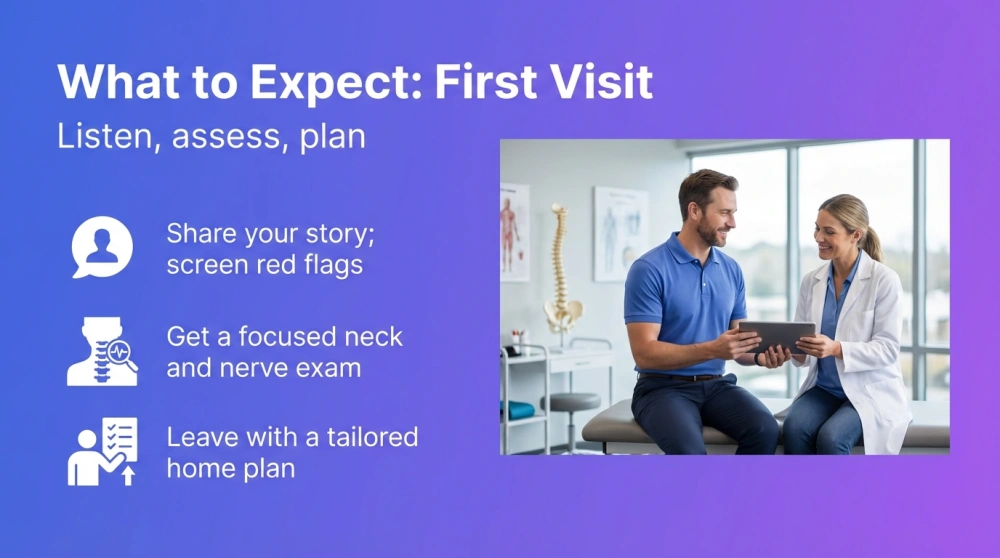
Your first visit focuses on listening and clarity. We want to learn your story, your goals, what has helped in the past, and what has not. We also cover safety and red flags to make sure your plan is appropriate from day one.
- History and screening We review headache features, timing, aura, triggers, medical conditions, and medication use, and we screen for warning signs that require medical referral [13].
- Focused exam Your clinician checks posture, cervical and thoracic motion, muscle tone, joint function, and neurologic reflexes. If needed, we coordinate imaging through your physician. Routine imaging is not always necessary for primary headache [4].
- Education and plan We outline how a nonpharmacological migraine treatment plan could look for you. This might include mobilization, specific adjustments, soft tissue techniques, and exercise. We agree on a plan to measure progress such as attack frequency, intensity, medication use, and function over time.
- Home strategies You leave with simple steps to start the same day. This often includes an ergonomic checklist, two to three mobility drills, a breathing practice, and your trigger tracker.
Throughout care we emphasize open communication. If your pattern changes in a way that suggests another cause such as a new neurologic deficit, fever, head trauma, or a thunderclap onset, we pause care and guide you to urgent or emergency medical evaluation [13].
Is chiropractic migraine care safe and who is not a good candidate?
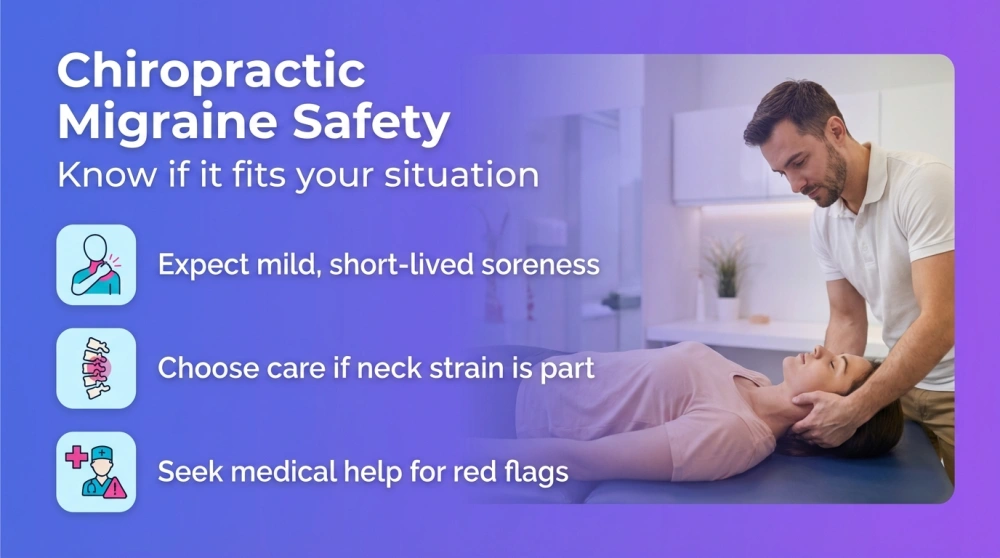
Conservative chiropractic care is considered safe for many patients when delivered by a licensed clinician who screens carefully and uses appropriate techniques. Common side effects are typically mild and short lived, such as temporary soreness or fatigue. Your chiropractor can explain the options and help you decide what techniques fit your situation and comfort level [6].
- Who is a good candidate Adults with a diagnosis or strong clinical suspicion of primary migraine, especially those with neck related symptoms or posture strain, who want to pursue a drug free strategy alongside medical care.
- Who may need medical evaluation first New or dramatically different headache, head pain after trauma, fever or stiff neck, neurologic symptoms such as weakness, numbness, vision loss, or confusion, or headaches that worsen with exertion or are worst at onset. These are reasons to prioritize medical evaluation [13].
- How we reduce risk We take time for history and exam, use the gentlest effective techniques, avoid end range movements if not appropriate, coordinate with your physician, and we always respect your preferences and informed consent [11].
What self care steps support drug free headache relief between visits?
Self care is the engine that powers long term change. Here are practical steps you can begin today and refine with your care team.
- Build a simple movement routine Start with three sessions each week of moderate activity that you enjoy. Walking, cycling, or swimming are common choices. Exercise programs have been shown to help reduce migraine frequency for many adults [9].
- Reset your workstation Adjust chair height, screen distance, and keyboard position so your neck is relaxed and shoulders are unshrugged. Use reminders for brief breaks to move and breathe [10].
- Practice a daily quiet minute Guided breathing or a brief relaxation drill can lower sympathetic arousal that often accompanies migraine patterns [5].
- Strengthen your neck and upper back Perform targeted exercises for the deep neck flexors and shoulder blade stabilizers to improve posture endurance and reduce strain.
- Keep a clean sleep window Consistent bed and wake times stabilize your system. Consider a wind down that includes screen limits, hydration, and a gentle stretch routine.
- Use your trigger tracker Track sleep, food, stress, activity, and symptoms for two to four weeks to spot patterns you can change. Bring it to your sessions so we can tailor your plan.
How do California rules guide chiropractic care for migraine?
In California, chiropractors are licensed and regulated by the California Board of Chiropractic Examiners. The Board sets standards for education, examination, scope of practice, and informed consent. Providers must follow California laws and regulations that define appropriate examination, diagnosis within scope, and referral when conditions fall outside chiropractic practice [11][12].
- Licensure and training California requires graduation from an accredited chiropractic college and successful completion of national and state examinations [11].
- Scope and coordination Chiropractors evaluate neuromusculoskeletal conditions and use conservative, noninvasive care. When findings suggest a secondary headache or a medical emergency, timely referral is required [11].
- Informed consent Your clinician must explain the nature of care, potential benefits and risks, and reasonable alternatives so that you can make a voluntary, informed choice [12].
These rules protect patients and support transparent, collaborative care. If you have questions about licensure or scope, you can review consumer resources directly through the Board [11].
What other questions do Santa Ana patients often ask about chiropractic care for migraines?
How many visits does it usually take to notice a change?
Plans are personalized. In research on nonpharmacologic migraine prevention and exercise therapy, programs often span 6 to 12 weeks with gradual changes in frequency and intensity over time [9]. Some people notice easier neck motion and less tension in the first few weeks. Sustainable change usually comes from a combination of clinic care and daily self care.
Can chiropractic care help if I already take migraine medication?
Yes. Many patients blend medical and nonmedical care in a coordinated plan. Behavioral and lifestyle strategies can enhance outcomes and sometimes reduce the need for acute medication over time. Always continue prescribed medications as directed and make changes only with your prescribing clinician [5].
Is there good evidence for atlas focused adjustments specifically?
The research base for specific named techniques, including atlas focused adjustments, is limited. Some trials and reviews suggest that carefully selected manual therapy may help reduce migraine days for some people, but results vary and high quality studies are still needed to know which methods work best for whom [7][8].
What if my headaches are mostly from stress and screen time?
That is a pattern we see often. A plan that blends posture coaching, workstation changes, regular movement, stress skills, and gentle hands on care can reduce neck and shoulder strain that may lower your threshold for attacks [10][5].
When should I go to urgent care or the emergency department?
Seek urgent medical care if you have a sudden worst ever headache, a new neurologic deficit like weakness, vision loss, or confusion, a headache with fever or stiff neck, or a headache after head injury. These are not situations for chiropractic care until cleared by a physician [13].
Can teenagers or older adults receive chiropractic care for migraines?
Care can be adapted for different ages. Safety screening, gentle techniques, and coordination with a pediatrician or primary care doctor are essential. Individual risks and goals guide each plan and some techniques are modified or avoided based on age and medical status [6].
How do I know if my neck is part of the problem?
Clues include neck stiffness, pain with certain positions, reduced rotation, or tenderness in the upper neck during or between headaches. A focused exam assesses joint motion and muscle tone to see whether mechanical factors are contributing. If the pattern points to a primary neurologic process without a neck component, your plan will focus more on triggers, sleep, and conditioning [14].
What outcomes should I track to judge progress?
Track the number of migraine days per month, attack intensity, use of acute medication, and how headaches affect work, school, and family life. We also track neck range of motion and posture tolerance during common tasks. A clear scorecard keeps your plan honest and adjustable.
How does OneAndOnlyChiro serve Santa Ana residents seeking migraine relief without medication?
At OneAndOnlyChiro, our mission is to help you build a sustainable plan for migraine relief without medication that respects your goals, medical history, and day to day realities. We are proud to serve Santa Ana and the wider Orange County community with thoughtful, evidence informed care and clear communication every step of the way.
- Where we operate We welcome patients from Santa Ana, CA and across Orange County. If you are searching for a migraine chiropractor Santa Ana patients trust for collaborative care, we are ready to help coordinate your plan with your primary provider or neurologist.
- Our approach We combine careful assessment, gentle manual therapy when appropriate, mobility and strength training, posture and ergonomics coaching, and education. We also help you implement a trigger tracking system and a home program that fits your schedule.
- Personalized care You receive one to one attention from qualified professionals who listen closely and tailor each session. We set shared goals and review your scorecard at regular intervals so you can see how far you have come.
- Tools and processes We provide a clear visit roadmap, an easy to use trigger tracker, and short videos for home exercises that support cervical spine alignment and posture endurance. We use outcome measures that track migraine days, intensity, medication use, and function over time.
- Experience and teamwork Our clinicians have years of combined experience helping people personalize drug free headache relief plans. We regularly coordinate with local physicians and physical therapists to keep your plan safe and complete.
- Education first You will learn why we recommend each step and how to adjust it when life gets busy. We want you to leave each visit with skills you can use the same day.
- Real world stories Patients often report fewer migraine days, easier neck movement, and improved tolerance for work and school tasks after committing to a combined program of manual care, exercise, and ergonomics. Results vary and we will be honest about what we see in your case.
- Local focus If you are comparing options for migraine treatment Santa Ana residents can access close to home, we invite you to talk with our team about your goals and concerns. For those looking for a headache chiropractor Orange County wide, we are conveniently located and ready to help you map the next steps.
We also created a free resource to help you get started. You can Download our Migraine Trigger Tracker and begin charting your sleep, hydration, meals, activity, stress, and symptoms. Bring it to your first visit so we can build a plan together.
If you are ready to take your next step, call us at (949) 800 8525 or message our team to schedule a consultation. Start Your Migraine Free Journey Today with a plan that blends clinic care and home strategies designed around you.
Where can you find the references used in this article?
- Migraine Information Page – National Institute of Neurological Disorders and Stroke
- Severe Headache or Migraine in Adults: United States, 2018 – Centers for Disease Control and Prevention
- Global Burden of Disease Summary for Migraine – Institute for Health Metrics and Evaluation
- The International Classification of Headache Disorders, 3rd edition – International Headache Society
- Integrating Behavioral Treatments Into Routine Migraine Care: A Consensus Statement – American Headache Society
- Chiropractic: In Depth – National Center for Complementary and Integrative Health
- Manual Therapy for the Prophylaxis of Migraine: A Systematic Review – The Journal of Headache and Pain
- Chiropractic Spinal Manipulative Therapy for Migraine: A Randomized Controlled Trial – Journal of Manipulative and Physiological Therapeutics
- Aerobic Exercise for Migraine: A Systematic Review and Meta Analysis – The Journal of Headache and Pain
- Computer Workstations eTool – Occupational Safety and Health Administration
- Laws and Statutes – California Board of Chiropractic Examiners
- Regulations – California Board of Chiropractic Examiners
- Headache Disorders Fact Sheet – World Health Organization
- The Trigeminocervical Complex and Headache – Brain
About the Author