Workers’ Compensation Chiropractor in Santa Ana: What OC Workers Need to Know
Workplace Injuries in Orange County: What the Numbers Show
If something happened to you at work around Santa Ana or somewhere else in Orange County, trust me, you’ve got company. Lots of it. Occupational injuries hit workers in pretty much every industry you can name, healthcare, manufacturing, logistics, retail, construction, the list keeps going. And according to the U.S. Bureau of Labor Statistics, hundreds of thousands of private-sector employees in California deal with nonfatal workplace injuries and illnesses each year, with a big share of those involving the musculoskeletal system, neck, back, upper extremities, the usual problem areas. [1] #ref-1
Santa Ana’s a lot. Dense as anything, technically one of the most densely populated cities in California, and it pulls double duty as the county seat of Orange County. The workforce? Spread thin across every industry imaginable, healthcare, warehouses, construction crews, you name it. And the workers here aren’t dealing with anything exotic, just the same occupational risks that show up across the state. Back strains, shoulder injuries, repetitive stress problems, soft-tissue trauma, those are the usual suspects when something goes wrong at work. Here’s the thing though. Most of those injuries actually respond pretty well to conservative, non-surgical care. Which is kind of where a chiropractor fits naturally into the picture.
For many injured workers, understanding how to navigate the workers’ compensation system and access appropriate care is genuinely confusing. This article is designed to explain what you need to know about workers’ compensation chiropractic care, the rules that govern it in California, and what the process looks like from the moment you’re injured to the point where you’re working toward recovery.
How California Workers’ Compensation Works for Injured Employees
California runs a no-fault workers’ comp system. It’s handled by the Division of Workers’ Compensation, or the DWC, which sits under the California Department of Industrial Relations (DIR). And here’s the part that matters most for you, practically every employer in the state is legally required to carry workers’ comp insurance. So if you got hurt on the job, or you came down with something because of your work environment, you’ve got a legal right to benefits. Doesn’t matter who was at fault, you, your employer, nobody, that piece is kind of beside the point. [2]
What benefits does workers’ comp cover?
California workers’ comp provides several types of benefits, including:
- Medical treatment: All reasonable and necessary medical care to cure or relieve the effects of a work-related injury or illness, with no upfront cost to you.
- Temporary disability (TD) payments: Partial wage replacement while you recover and cannot return to your regular duties.
- Permanent disability (PD) benefits: Compensation if your injury results in a lasting impairment.
- Return-to-work assistance: Supplemental job displacement vouchers and the Return-to-Work Supplement Program in some cases.
What are the time limits to be aware of?
One of the most important things to know is that time matters. Under California law, you should report your injury to your employer as soon as possible. Failing to report within 30 days of the injury can put your right to benefits at risk. Once you file a claim, your employer or their insurer is required to authorize medical care. [2]
The claims administrator has the right to direct your medical care for the first 30 days after they are notified of the injury. After that 30-day window, you have greater freedom to choose your own treating physician, subject to the rules of your employer’s medical provider network (MPN), if one exists. [3]
Chiropractic Care Under California Workers’ Comp: What Is Covered?
Chiropractic treatment is explicitly recognized as a covered form of medical care under California’s workers’ compensation system. [3] Chiropractors are licensed healthcare providers who can serve as treating physicians within the workers’ comp framework, and their services are billed directly to the claims administrator, meaning you do not pay out of pocket.
Is there a limit on chiropractic visits under workers’ comp?
Yes. California workers’ compensation law places a cap on chiropractic visits for most claims. After you have received 24 chiropractic visits, a chiropractor cannot continue to serve as your primary treating physician. [3] This does not necessarily mean chiropractic care ends at 24 visits for all conditions, but it does mean the role of the chiropractor within your care team may shift. For workers with complex or chronic occupational injuries, it is worth discussing ongoing care options with both your chiropractor and your claims administrator.
What does the MTUS say about chiropractic treatment?
All medical treatment within the California workers’ compensation system must align with the Medical Treatment Utilization Schedule (MTUS). The MTUS is an evidence-based set of guidelines developed by the DWC to define the frequency, duration, and scope of appropriate medical care for specific work-related conditions. Chiropractic interventions, including spinal manipulation, manual therapy, and rehabilitative exercises, are addressed within the MTUS for conditions such as low back pain, neck pain, and related musculoskeletal disorders. [4]
The workers compensation chiropractor Santa Ana patients work with must follow these guidelines when submitting treatment requests. Your care plan will generally need to be supported by clinical evidence and may be subject to a utilization review (UR) process before certain treatments are authorized.
Common Workplace Injuries That Chiropractic Care Addresses
Not every workplace injury requires surgery or long-term medication management. Many of the most common occupational injuries involve the spine, joints, and surrounding soft tissues, and these are exactly the types of conditions that respond well to evidence-based chiropractic treatment. [5]
Which work injuries are most commonly treated by chiropractors?
- Low back strain and sprain: One of the most frequent workplace injuries, often caused by heavy lifting, awkward postures, or sudden movements. Back injuries consistently rank among the leading causes of occupational disability in the United States. [1]
- Cervical (neck) strain: Common in workers who perform repetitive or sustained forward-flexed postures, including warehouse, healthcare, and office environments.
- Shoulder and upper extremity conditions: Rotator cuff strain, tendinopathy, and repetitive-use injuries affecting the arm, wrist, or hand are frequently seen in manufacturing, retail, and food service workers.
- Work-related musculoskeletal disorders (WMSDs): The CDC’s National Institute for Occupational Safety and Health (NIOSH) defines WMSDs as injuries or disorders affecting the muscles, nerves, tendons, joints, and supporting tissues that arise from or are aggravated by workplace conditions such as force, repetition, vibration, and awkward posture. [5]
- Slip-and-fall injuries: Contusions, joint sprains, and spinal trauma resulting from trips, slips, or falls in the workplace.
- Cumulative trauma: Gradual injuries that develop over time due to sustained or repeated physical demands of a job.
Chiropractic treatment for workplace injuries in Santa Ana typically combines spinal adjustment or manipulation, soft-tissue therapies, rehabilitative exercise, and patient education. The goal is to reduce pain, restore function, and support a safe return to work.
How to Access a Workers’ Compensation Chiropractor in Santa Ana
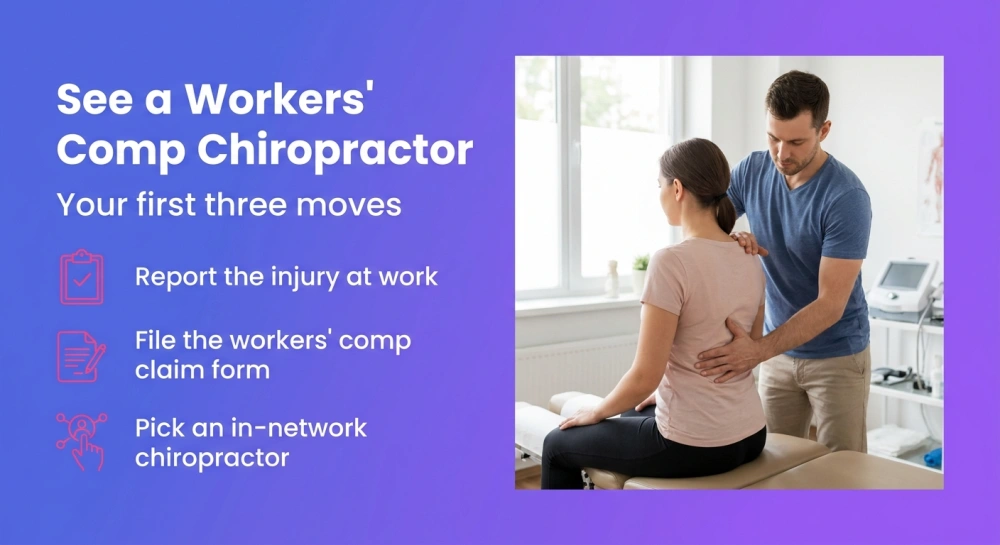
The path to seeing a chiropractor after a work injury depends on several factors, including whether your employer has a Medical Provider Network, whether you predesignated a treating physician, and how quickly you act after the injury occurs. Here is what the process generally looks like in California.
What is a Medical Provider Network (MPN) and how does it affect your choices?
An MPN is a state-approved network of physicians and other licensed healthcare providers selected by an employer or their insurer to treat injured workers. [3] If your employer uses an MPN, you are required to receive your initial and ongoing care from MPN providers, except in emergency situations. MPNs must include providers with expertise in occupational health, and most established networks include licensed chiropractors.
If your employer does not have an MPN, you still have options. Within the first 30 days after the injury is reported, the claims administrator directs your care. After that window, you may choose your own provider from within a reasonable geographic area. Workers seeking chiropractic treatment for workplace injuries in Santa Ana should contact their claims administrator or human resources department as soon as possible to clarify which pathway applies to them.
Can you predesignate a chiropractor before an injury occurs?
Yes, California law allows you to predesignate a personal chiropractor or acupuncturist before you are injured. To do this, you must provide your employer with the name and business address of the provider in writing before the injury takes place. If you predesignated a chiropractor, you may be able to transfer care to that provider after 30 days, even if your employer has an MPN. [3] This is a practical step worth discussing with your employer before any workplace incident occurs.
What happens right after you are injured?
If you experience a work injury, the first step is to notify your supervisor immediately and seek appropriate medical attention. Your employer is required to provide you with a Workers’ Compensation Claim Form (DWC 1) within one working day of learning about your injury. Complete and return this form as soon as possible. Under California law, medical care must be paid for by your employer once a claim is filed, and you should never receive a bill for treatment of a confirmed work-related injury. [2]
Injury Documentation and Why It Matters for Your Claim
One of the areas where workers’ comp claims most often run into problems is documentation. Thorough, accurate, and timely documentation of your injury and its connection to your work is critical for protecting your right to benefits, including chiropractic care.
Why is injury documentation so important in workers’ comp cases?
In California, workers’ compensation disputes frequently involve questions about whether an injury is work-related, the severity of the injury, and whether requested treatments are medically necessary. Strong documentation at every stage, starting from the moment of injury, can make a significant difference in how smoothly your claim is handled.
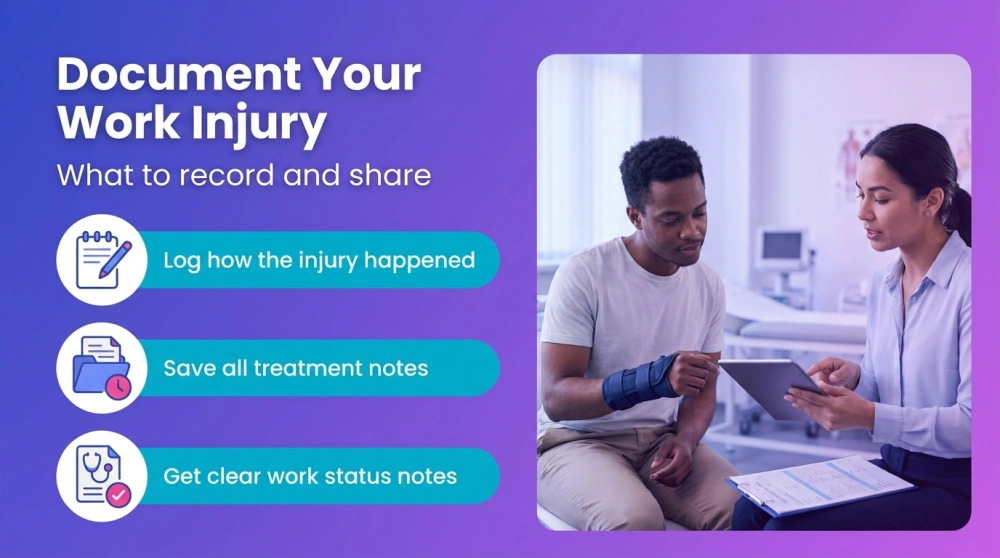
A treating chiropractor who is experienced with workers’ comp cases understands how to create the clinical documentation that supports the claim, including:
- Initial evaluation reports: Documenting the mechanism of injury, symptoms, functional limitations, and relationship to the work environment.
- Progress notes: Ongoing records of treatment provided, clinical findings, and patient response to care.
- Work status notes: Clear communication to employers and claims administrators about the patient’s ability to return to work, with or without modified duties.
- Request for Authorization (RFA) forms: Formal requests submitted to the claims administrator when treatment requires prior authorization.
Good documentation also protects you if your claim is questioned or disputed. The Commission on Health and Safety and Workers’ Compensation (CHSWC), a joint labor-management advisory body in California, notes that disputes over medical treatment are among the most common sources of conflict in workers’ compensation cases. [6]
Understanding the MTUS and Treatment Authorization
As mentioned earlier, all medical treatment within the California workers’ comp system must comply with the Medical Treatment Utilization Schedule. Understanding how this works can help you advocate for your own care and avoid unnecessary delays. [4]
What happens if treatment is delayed or denied?
Under California law, all employers and claims administrators handling workers’ compensation claims are required to have a Utilization Review (UR) program. When your treating chiropractor requests authorization for treatment, the UR program evaluates whether the requested care meets the MTUS guidelines. [3]
If your treatment request is denied or modified through UR, you have the right to appeal. The first level of appeal goes to Independent Medical Review (IMR), a process administered by the DWC in which an independent physician evaluates whether the decision was consistent with evidence-based guidelines. [7] You also have the option to contact the DWC Information and Assistance Unit, which provides free help to injured workers navigating the system.
How does the treating chiropractor navigate the authorization process?
A chiropractor who regularly works within the workers’ comp system will be familiar with the UR process and the specific documentation required to support authorization requests. They will also know how to communicate with the claims administrator in a way that facilitates rather than delays your care. This experience matters, particularly for workers dealing with injuries that require a longer course of treatment or multiple types of intervention.
Choosing the Right Treatment Provider Under Workers’ Comp
Workers’ comp cases involving chiropractic care work best when the treating chiropractor has specific experience navigating California’s workers’ compensation system. This is a specialized area, and providers who are unfamiliar with it can unintentionally create delays or documentation gaps that complicate the claim.
What should an injured worker look for in a workers’ comp chiropractor in Santa Ana?
When considering a workers’ compensation chiropractor in Santa Ana, some factors to think about include:
- Acceptance of workers’ comp insurance: Not all chiropractic clinics accept workers’ compensation as a form of payment. Confirm this upfront before scheduling.
- Familiarity with the MTUS and UR process: A provider who understands California’s treatment guidelines is better positioned to move your care forward without unnecessary delays.
- Experience with occupational injuries: Workplace injuries often involve specific mechanisms that differ from everyday musculoskeletal complaints. Relevant clinical experience is valuable.
- Communication with employers and claims administrators: A chiropractor who communicates clearly and promptly with the claims administrator helps keep your claim on track.
- Capacity to provide work status documentation: Getting accurate, timely work status notes is essential for modified-duty arrangements and return-to-work planning.
Workers seeking chiropractic treatment for workplace injuries in Santa Ana will also want to confirm whether the clinic is part of their employer’s MPN, or whether they qualify to see a non-network provider under the circumstances of their claim.
Chiropractic Care and the Path Back to Work
One of the primary goals of workers’ comp care, including chiropractic treatment, is to support a safe and timely return to work. This is true for both the injured worker and for the employer, and it is a goal explicitly built into California’s workers’ compensation framework. [8]
How does chiropractic care support return-to-work outcomes?
Chiropractic treatment for work injuries focuses on restoring function, reducing pain, and improving the physical capacity needed to perform job duties. For workers in physically demanding roles, this might mean rebuilding strength, flexibility, and joint stability. For those in sedentary roles, it might involve addressing postural dysfunction, nerve irritation, or repetitive-use conditions that affect daily work performance.
Evidence-based chiropractic care for occupational injuries typically includes a combination of spinal manipulation where clinically indicated, soft-tissue therapy, therapeutic exercise, and patient education about injury prevention and workplace ergonomics. NIOSH recognizes workplace musculoskeletal disorders as preventable through ergonomic intervention and appropriate early care, making timely treatment an important factor in recovery outcomes. [5]
For some workers, modified-duty arrangements during recovery are appropriate. A chiropractor familiar with workers’ comp cases can issue functional capacity assessments and work status forms that communicate your specific restrictions and capabilities to your employer, helping to facilitate a gradual, supervised return to full duties.
What about cases that involve multiple providers or a longer recovery?
Complex workplace injuries sometimes require a team approach, with chiropractic care forming one part of a broader treatment plan that may include physical therapy, orthopedic evaluation, pain management, or psychological support. In these cases, the treating chiropractor should coordinate care with other providers and ensure that all treatment aligns with the active workers’ comp claim. If your injury is more serious, your chiropractor may refer you to a qualified medical evaluator (QME) for an independent assessment of your level of impairment. [3]
A Note for HR Professionals in Santa Ana and Orange County
If you work in human resources at a company in Santa Ana, Tustin, or another Orange County community, understanding how workers’ compensation chiropractic care fits into your injury management process can help you support employees more effectively and reduce costs associated with delayed treatment or prolonged disability.
What should HR departments know about managing chiropractic workers’ comp claims?
- Early intervention matters: Connecting injured workers with appropriate care quickly, including chiropractic evaluation for musculoskeletal complaints, is associated with better return-to-work outcomes and lower overall claim costs.
- MPN compliance is required: If your company has a state-approved MPN, ensure that your injured workers are aware of which providers they can see and how to access them. Provide the MPN list in a timely manner as required by California law. [3]
- Modified duty programs facilitate recovery: Working with treating chiropractors to establish appropriate modified-duty assignments helps keep injured employees engaged while they recover, which typically shortens the duration of temporary disability.
- Communication is key: Establish clear communication channels between HR, the claims administrator, and treating providers. A coordinated approach reduces confusion and keeps claims moving forward.
The CHSWC publishes resources and guidelines for employers on managing work injuries effectively, and the DWC offers free educational workshops and informational materials for both workers and employers across California. [6]
Frequently Asked Questions
Do I have to pay anything out of pocket to see a workers’ compensation chiropractor in Santa Ana?
No. Under California workers’ compensation law, all reasonable and necessary medical treatment for a work-related injury must be paid by your employer or their insurer. You should not receive any bill for chiropractic care that is part of an approved workers’ comp claim. If your claim has been accepted, inform your chiropractor at the time of your first visit that the injury is work-related and that a workers’ comp claim is in place. [3]
Can I choose my own chiropractor, or does my employer control who I see?
This depends on whether your employer has a Medical Provider Network (MPN) and whether you predesignated a chiropractor before the injury occurred. In general, your employer or claims administrator directs your medical care for the first 30 days after they learn of the injury. After 30 days, you have more freedom to choose a provider within a reasonable geographic area, subject to MPN rules. If you predesignated a personal chiropractor in writing before the injury, you may be able to transfer to that provider after 30 days. [3]
What types of treatment can a chiropractor provide under a workers’ comp claim?
A licensed chiropractor within the workers’ comp system can provide spinal manipulation, manual therapy, soft-tissue treatment, therapeutic exercise, and rehabilitation services. All care must align with the California Medical Treatment Utilization Schedule (MTUS) and may require prior authorization through the utilization review process. Treatment goals focus on pain relief, restoration of function, and return to work. [4]
What happens if I was injured in Santa Ana but live in Tustin or another nearby city?
Your California workers’ compensation claim is based on where the injury occurred and where you are employed, not necessarily where you live. Workers’ comp benefits apply regardless of your city of residence within California. You can generally receive treatment from a chiropractor within a reasonable geographic area, which may well include providers in Tustin, Anaheim, Orange, or other nearby Orange County communities depending on where your employer’s MPN has participating clinics.
How long will workers’ comp chiropractic care last?
The duration of chiropractic care under workers’ comp depends on your specific injury, your response to treatment, and the clinical guidelines established in the MTUS. California law limits the number of chiropractic visits for which a chiropractor can serve as your primary treating physician to 24 visits. Beyond that, ongoing care may be coordinated through a different treating provider or authorized on a case-by-case basis through the utilization review process. [3]
What if my workers’ comp claim is denied?
If your claim is denied, you have the right to appeal. The DWC Information and Assistance Unit provides free help to injured workers and can guide you through the dispute resolution process, which may include mediation, hearings before a workers’ compensation judge, or review by the Workers’ Compensation Appeals Board (WCAB). It is also advisable to consult with a workers’ compensation attorney if your claim has been denied, as many attorneys in this area offer free initial consultations. [2]
Can I see a chiropractor for a cumulative trauma injury rather than a single accident?
Short answer? Yes. California workers’ comp covers cumulative trauma injuries, not just the dramatic one-moment incidents. So if your injury kind of crept up on you over months or years, maybe from repetitive motions or sustained physical demands at work, you’re likely still eligible for benefits, chiropractic treatment included. The hard part isn’t qualifying. It’s proving the link. You’ve gotta show that your condition is causally tied to your work environment, and honestly, that comes down to a careful clinical exam paired with really solid documentation. [2] #ref-2 #ref-2 #ref-2 #ref-2
About One & Only Chiropractic: Workers’ Comp Care in Santa Ana and Orange County
If you’ve been injured at work and are looking for a chiropractic clinic that accepts workers’ compensation insurance in the Santa Ana and Orange County area, One & Only Chiropractic is here to support your recovery.
Picture a wellness and injury clinic that doesn’t quietly disappear after appointment one. That’s us. We treat injured workers from across Orange County, folks coming in from Santa Ana, Tustin, Anaheim, Orange, and the surrounding neighborhoods. Our approach to occupational injuries leans evidence-based and patient-centered, which basically just means we slow down, we actually listen, and we tailor your care instead of running a script. We spend real time on the initial evaluation to document the injury clearly. Then we build a care plan that follows the California Medical Treatment Utilization Schedule (MTUS), which keeps things clinically defensible and compatible with how workers’ comp authorization actually works. That last part? Way more important than it gets credit for.
Our team has been doing this a while. We know the workers’ comp system from the inside, the paperwork, the timing, the personalities. We accept workers’ comp insurance, we talk directly to claims administrators and adjusters when something needs to be sorted out, and we send in documentation on time and structured the way it actually has to be. The point is keeping your care moving, first visit through return to work. And honestly, we know how frustrating it feels to be lost in this system after you’ve already been hurt, that’s part of why we make a real effort to keep you in the loop. Nobody should be guessing about their own recovery.
What makes our approach different?
- Personalized care plans: We do not take a one-size-fits-all approach. Every patient receives an individualized assessment and a treatment plan tailored to their specific injury, job demands, and recovery goals.
- Comprehensive injury documentation: We prepare thorough initial reports, progress notes, and work status forms that support your workers’ comp claim and keep your employer and claims administrator informed.
- Coordination across care teams: For complex injuries, we coordinate with referring physicians, physical therapists, and other providers to make sure your care is cohesive and goal-directed.
- Support for all stages of recovery: From acute pain management to rehabilitative exercise and return-to-work planning, our team supports you throughout the full recovery process.
- Serving a wide patient population: We care for adults across all age groups and occupational backgrounds, from warehouse workers and construction laborers to healthcare professionals and office employees.
One & Only Chiropractic serves patients throughout Santa Ana and the broader Orange County region, including Tustin. Our clinic positions itself as a trusted resource for injured workers who want clear, professional guidance and hands-on care without the run-around that can sometimes come with workers’ comp cases.
Injured at work? We accept workers’ compensation insurance. Call (949) 800-8525 for a same-week evaluation. No upfront cost to you.
References
- Injuries, Illnesses, and Fatalities Program – U.S. Bureau of Labor Statistics
- I Was Injured at Work – California Division of Workers’ Compensation (DWC)
- Medical Care for Injured Workers – California Division of Workers’ Compensation (DWC)
- Medical Treatment Utilization Schedule (MTUS) – California DWC
- Ergonomics and Work-Related Musculoskeletal Disorders – CDC/NIOSH
- Commission on Health and Safety and Workers’ Compensation (CHSWC) – California DIR
- Independent Medical Review (IMR) – California Division of Workers’ Compensation
- Return-to-Work Supplement Program – California DIR
- Division of Workers’ Compensation – California Department of Industrial Relations
- Information and Assistance Unit – California Division of Workers’ Compensation
- Employer Information – California Division of Workers’ Compensation
About the Author