Sports Performance Optimization: How Orange County Athletes Cut Recovery Time by 40%
- What does sports performance optimization actually mean for athletes in Santa Ana?
- Why do athletes focus so much on recovery time?
- Can athletes really cut recovery time by 40 percent?
- What happens in the body during athletic recovery?
- Which sports injuries most often slow performance in active people?
- How can chiropractic care support faster recovery for athletes?
- What role do mobility and biomechanics play in performance?
- Which recovery strategies matter most beyond treatment visits?
- How do local training demands in Santa Ana affect athletes?
- When should an athlete seek professional help?
- What can you expect from a sports focused chiropractic evaluation?
- How can athletes build a smarter weekly recovery plan?
- What mistakes often keep athletes stuck in a recovery cycle?
- How does OneAndOnlyChiro support athletes in Santa Ana, California?
- References
What does sports performance optimization actually mean for athletes in Santa Ana?
Sports performance optimization is not just about running faster, lifting more, or getting back on the field as soon as possible. For most athletes, it means improving how the body moves, recovers, adapts to training, and handles physical stress over time. In practical terms, that includes mobility, strength balance, joint function, sleep quality, training load, hydration, nutrition, and recovery planning.
For athletes in Santa Ana, California, this topic matters because training often happens year round. Whether you compete in soccer, baseball, softball, basketball, martial arts, track, cycling, CrossFit, or recreational endurance events, repeated loading without enough recovery can limit progress and increase the risk of pain or overuse issues. Research from the Centers for Disease Control and Prevention shows that sports and recreation activities contribute to a large share of injury related emergency visits among children and adults, reminding us that performance and injury prevention are closely connected [1].
When we talk about sports performance optimization Orange County athletes often want answers to simple questions. Why am I sore for so long after training? Why does one side feel tighter? Why do I keep dealing with the same shoulder, knee, or low back issue? The goal is to look beyond symptoms and understand the movement habits and recovery patterns affecting performance.
A helpful approach is not built on one treatment or one exercise. It usually involves a coordinated plan that supports tissue recovery, monitors training stress, improves movement efficiency, and helps the athlete return to sport with better control and confidence.
Why do athletes focus so much on recovery time?
Recovery time matters because adaptation happens after training, not only during it. Training creates stress. Recovery is when the body rebuilds tissue, restores energy stores, regulates inflammation, and rebalances the nervous system. If recovery is too slow or incomplete, the athlete may feel heavy, stiff, fatigued, or mentally flat. That can affect performance quality and increase injury risk.
The American College of Sports Medicine describes recovery as a meaningful part of athletic readiness rather than an optional add on [2]. This idea is supported by a large body of sports medicine research showing that fatigue management, sleep, and load monitoring influence performance and return to play decisions [3].
For athletes, faster recovery does not mean rushing back before the body is ready. It means reducing avoidable delays. If a runner has limited hip mobility, a pitcher has poor thoracic rotation, or a volleyball player keeps landing with poor mechanics, the body may be doing extra work every session. Correcting those issues can reduce strain and help the athlete recover more efficiently between workouts.
That is why many people looking for athlete recovery chiropractic Santa Ana services are not simply chasing symptom relief. They are trying to understand what keeps disrupting their consistency.
Can athletes really cut recovery time by 40 percent?
The phrase cut recovery time by 40 percent can be a useful headline, but it should be handled carefully. Recovery is not one single measurement, and no ethical provider should suggest that every athlete will improve by the same amount. Recovery speed depends on the injury type, sport, age, training volume, sleep, nutrition, stress, treatment timing, and whether the athlete follows a plan consistently.
What the research does support is that a structured, multimodal approach can improve return to function, reduce symptom duration in some conditions, and help athletes resume training more efficiently than doing nothing or relying on a single passive strategy alone. For example, sports medicine literature supports active rehabilitation, graded loading, and individualized treatment plans for many musculoskeletal conditions [4].
So when athletes in Santa Ana talk about a 40 percent improvement, that should be understood as a possible outcome in selected cases with measurable benchmarks such as reduced soreness duration, quicker return to training volume, shorter downtime after flare ups, or better movement quality. It is not a universal promise.
A more accurate way to think about it is this:
- Recovery can improve meaningfully when contributing factors are identified early.
- Targeted care can reduce wasted time spent resting without a clear plan.
- Performance support works best when treatment, exercise, and training decisions align.
What happens in the body during athletic recovery?
Recovery is a whole body process. Muscles repair microscopic tissue damage from training. The nervous system settles after intense output. Glycogen stores are replenished. Connective tissue adapts more slowly than muscle, which is one reason tendons and ligaments can become overloaded if training increases too quickly. Sleep also plays a major role in hormonal regulation, cognitive recovery, and tissue repair.
The National Institutes of Health and sports medicine researchers have repeatedly linked inadequate sleep with poorer reaction time, impaired decision making, and lower recovery quality in athletes [5]. This is especially relevant for students and working adults balancing training with academic, job, and family demands.
Inflammation is another part of the picture. Short term inflammation is a normal response to training and tissue stress. Problems arise when loading exceeds capacity or when recovery systems are compromised. That is why clinicians often assess more than the painful area. A sore knee may involve ankle stiffness, hip weakness, trunk control deficits, or training errors.
In this setting, chiropractic care for sports injuries may be one part of a broader recovery strategy when it is used to address joint motion, soft tissue irritation, and movement dysfunction within the provider’s scope and in coordination with exercise and medical referral when needed.
Which sports injuries most often slow performance in active people?
Many athletic problems are not dramatic one time injuries. They build gradually. The most common performance limiting issues often include:
- Sprains and strains that affect ankles, hamstrings, groin muscles, and shoulders.
- Overuse tendon pain such as patellar tendon pain, Achilles tendon pain, and rotator cuff related symptoms.
- Low back pain linked to repetitive rotation, extension, lifting, or impact loading.
- Neck and upper back stiffness that affects posture, breathing, and overhead mechanics.
- Running related issues including shin pain, iliotibial band symptoms, and plantar heel pain.
- Mobility restrictions that reduce stride efficiency, squat depth, throwing mechanics, or change of direction control.
The National Safety Council reports that exercise equipment, cycling, basketball, and football are among the activities associated with many sports and recreation injuries treated each year [6]. The exact mix in Santa Ana may vary, but the larger pattern is clear. Active people often need help with recurring mechanical stress rather than only acute trauma.
That is one reason a sports chiropractor Santa Ana athletes trust may spend time looking at mechanics, movement history, training load, and not just where the pain shows up today.
How can chiropractic care support faster recovery for athletes?
Chiropractic care can support athletic recovery by focusing on musculoskeletal function, movement assessment, and conservative treatment strategies that fit the athlete’s goals. Depending on the case, this may include spinal or extremity joint treatment, soft tissue techniques, mobility work, corrective exercise, postural assessment, and education about activity modification.
The key point is that chiropractic care should not be presented as a stand alone fix for every sports injury. Instead, it can be part of an evidence informed care plan. Clinical practice guidelines for common musculoskeletal conditions such as low back pain support nonpharmacologic approaches including manual therapy and exercise in appropriate cases [7]. For athletes, the value often comes from combining hands on care with movement retraining and recovery planning.
Potential ways this helps include:
- Improving joint motion when restricted movement is affecting performance mechanics.
- Reducing pain sensitivity enough to allow more productive rehab and training progression.
- Supporting movement quality through assessment of asymmetry, compensation, and control.
- Guiding load management so the athlete does not move from rest straight back into overload.
- Identifying referral needs when symptoms suggest imaging, medical evaluation, or co management.
For some athletes, muscle recovery treatment Orange County programs may include soft tissue work, targeted mobility, exercise progressions, and return to activity planning. The goal is not simply to feel looser for a day. It is to support function that holds up under training demands.
What role do mobility and biomechanics play in performance?
Mobility and biomechanics shape how efficiently force moves through the body. If one joint is not doing its share, another region often compensates. Over time, those compensations can reduce output and increase stress.
Consider a few examples:
- Limited ankle mobility can alter squatting, sprint mechanics, and landing control.
- Reduced hip rotation can affect cutting, running, and rotational power in golf, baseball, and tennis.
- Thoracic stiffness can influence breathing, overhead movement, and trunk rotation.
- Poor trunk control can increase stress on shoulders, knees, and the low back.
Biomechanics is not about chasing a perfect movement pattern for every athlete. It is about finding inefficiencies that matter for that person’s sport, position, and injury history. Research in sports science supports individualized movement assessment because athletes adapt differently to similar training loads [8].
When mobility and performance enhancement become part of a structured care plan, athletes often notice that they warm up more easily, recover better after competition, and maintain technique later in sessions when fatigue sets in.
Which recovery strategies matter most beyond treatment visits?
Many athletes assume recovery depends mainly on what happens in the clinic. In reality, most recovery happens away from the treatment table. That is where daily habits matter.
The most consistently supported strategies include:
- Sleep quality because reduced sleep is associated with slower recovery, lower reaction time, and higher injury risk [5].
- Nutrition and protein intake to support tissue repair and energy restoration [9].
- Hydration because even mild dehydration can affect exercise performance and thermoregulation [10].
- Load management to avoid sharp spikes in training volume or intensity.
- Active recovery such as light movement, mobility work, and circulation based exercise when appropriate.
- Technique and mechanics review especially if symptoms return during the same drills or lifts.
Athletes looking for faster recovery for athletes often overlook the basics because they are less exciting than advanced tools. Compression boots, contrast therapy, and tracking devices may be useful in some settings, but they work best when the fundamentals are already in place.
In Santa Ana, where many athletes balance school schedules, commutes, work, and club sports, consistency with sleep and recovery routines can be harder than it sounds. That makes simple, repeatable systems more valuable than complicated protocols.
How do local training demands in Santa Ana affect athletes?
Santa Ana athletes often train across school seasons, club schedules, gym programs, and outdoor recreation. Southern California weather also encourages more frequent year round activity than in colder regions. That can be a positive for conditioning, but it can also mean fewer true off seasons.
When there is no meaningful break, overuse patterns may build gradually. Youth athletes may move from school sports to travel teams with little downtime. Adults may combine recreational leagues, distance races, and strength training in the same month. In these settings, athletic injury prevention chiropractic strategies can be useful when they focus on early warning signs, movement screening, and training balance rather than waiting for pain to become severe.
Local context matters in another way too. Access to parks, gyms, courts, fields, and coastal training options creates variety, but changing surfaces and sport demands can stress tissues differently. Someone who alternates between treadmill running, outdoor sprints, beach workouts, and heavy lifting may need a more deliberate mobility and strength maintenance plan than they realize.
This is part of why Santa Ana sports performance optimization conversations should include the athlete’s actual weekly routine, not just a diagnosis label.
When should an athlete seek professional help?
It is time to seek professional evaluation when pain is persistent, movement feels restricted, symptoms keep returning, or performance drops without a clear reason. An athlete should also seek prompt medical attention if there is significant swelling, suspected fracture, numbness, weakness, head injury, loss of function, or pain that is sharp and worsening.
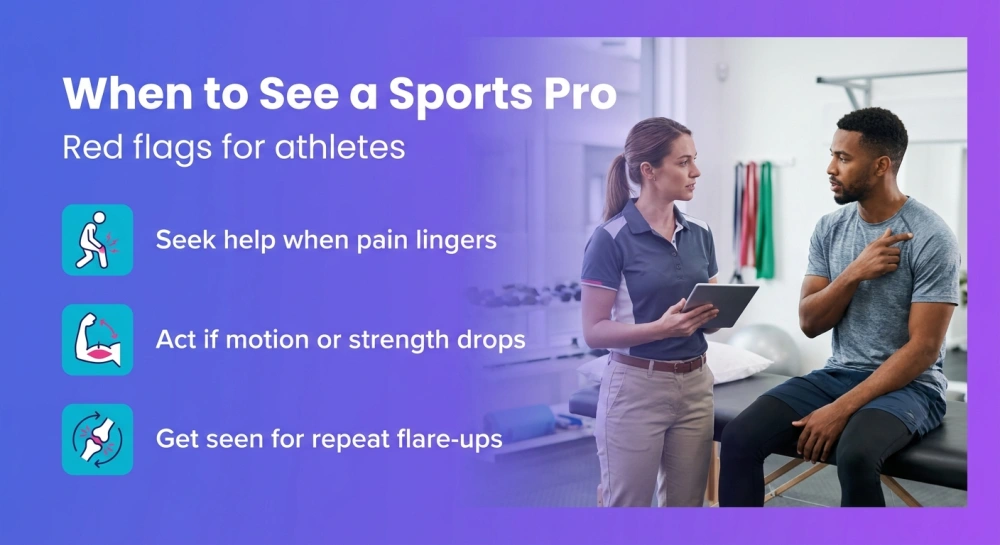
You should not try to push through every symptom. Early care is often more useful than waiting until compensation patterns become stronger and training has already declined.
Professional help may be especially important when:
- Pain lasts more than several days and is not improving with reasonable rest and activity changes.
- You keep re injuring the same area during similar drills, lifts, or competitions.
- Range of motion is limited compared with your normal movement.
- Strength or coordination feels off on one side.
- You are unsure whether to train, modify, or stop.
For many athletes, getting evaluated does not mean they need to stop all activity. It means they need a more precise plan. A provider can help determine what is safe to continue, what should be modified, and when referral to another clinician is appropriate.
What can you expect from a sports focused chiropractic evaluation?
A sports focused chiropractic evaluation usually starts with your history. That includes the sport you play, training frequency, when symptoms started, what movements provoke them, previous injuries, and what your goals are. From there, the exam may include posture, range of motion, strength, balance, orthopedic testing, palpation, and movement assessment specific to your sport.
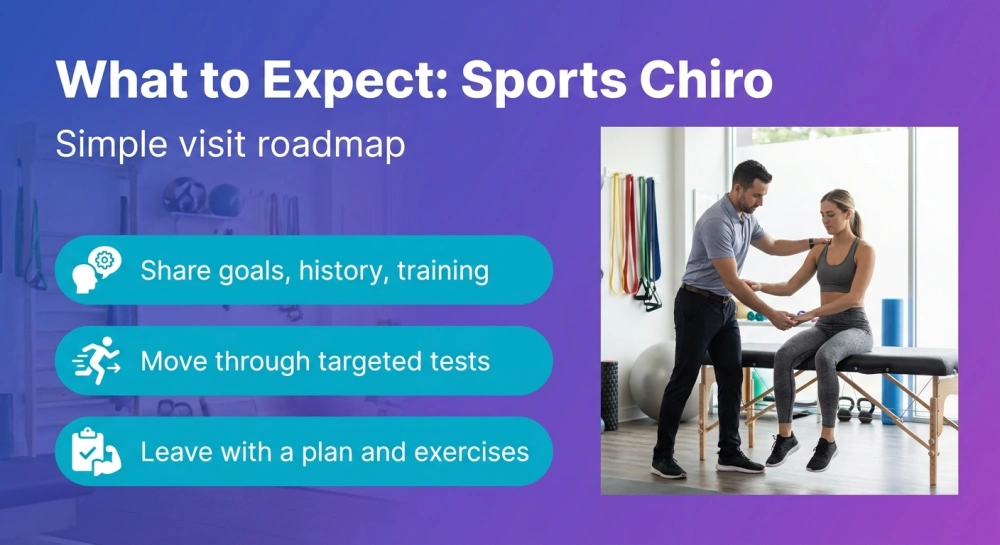
A thoughtful evaluation should also ask about sleep, recovery habits, training spikes, and outside stress. Those factors often explain why symptoms persist.
You can typically expect discussion around:
- What structure or movement pattern may be involved.
- Whether the issue seems mechanical, inflammatory, or load related.
- What conservative treatment may help within chiropractic scope.
- What home exercises or activity changes fit your sport.
- Whether referral is needed for imaging, medical evaluation, or another specialist.
If you are comparing options for athlete recovery chiropractic Santa Ana care, it is reasonable to ask whether the provider works with active individuals, how they handle return to play decisions, and how treatment is paired with corrective exercise and monitoring.
Many new patients also want to know what a first visit feels like. A clear step by step walkthrough, simple explanations, and enough time to ask questions can lower first visit anxiety. Educational tools such as a virtual office tour, meet the team videos, and a first visit overview may help athletes feel more prepared before arriving.
How can athletes build a smarter weekly recovery plan?
A smart recovery plan is realistic enough to follow. It does not need to be complicated. It should match your training volume, sport demands, and current symptoms.
A useful weekly framework often includes:
- One review of training load to see whether volume or intensity increased too quickly.
- Daily mobility work focused on your most limited regions rather than random stretching.
- At least one lower intensity day that still includes movement.
- Consistent sleep timing even on weekends when possible.
- Fueling after hard sessions with adequate carbohydrate and protein intake [9].
- Reassessment of recurring soreness so small issues do not become bigger ones.
It may also help to track a few simple markers:
- Morning soreness level
- Perceived energy
- Sleep duration
- Training intensity
- Any change in movement confidence
These notes can reveal patterns. For example, if knee soreness spikes after two consecutive high intensity leg days, the answer may be scheduling and load control, not just another passive treatment visit.
What mistakes often keep athletes stuck in a recovery cycle?
Many athletes are highly motivated, but motivation alone can backfire if recovery decisions are inconsistent. A few common mistakes tend to prolong problems:
- Ignoring early warning signs because pain is still tolerable.
- Returning to full intensity too quickly after a flare up.
- Relying only on passive care without addressing strength, mechanics, or load.
- Changing too many variables at once which makes it hard to identify what helped or worsened symptoms.
- Using generic online advice that does not fit your sport, age, or injury history.
Another common mistake is assuming that if pain is reduced, the issue is fully resolved. Symptoms can improve before capacity is restored. That is why follow through matters. A return to sprinting, jumping, cutting, or heavy lifting should be progressive.
For athletes dealing with recurring restrictions, Santa Ana sports chiropractor visits may be most helpful when they are part of a larger plan that includes clear progression markers rather than only symptom based decisions.
How does OneAndOnlyChiro support athletes in Santa Ana, California?
At OneAndOnlyChiro, the focus is on helping active people understand what their bodies are telling them and what practical next steps may support recovery and movement quality. As a wellness and injury clinic, the practice works from a personalized, evidence based model that aims to address pain, support function, and improve long term mobility through conservative care.
For athletes in Santa Ana, California and nearby Orange County communities, that means care is not limited to a quick symptom check. The process can include movement assessment, chiropractic treatment when appropriate, exercise guidance, education about recovery habits, and referral when a condition falls outside chiropractic scope. This can be especially relevant for athletes trying to balance competition schedules, training goals, and day to day pain or stiffness.
OneAndOnlyChiro serves patients across a wide age range, including adult athletes, youth athletes with family support, and active individuals returning from setbacks. The clinic’s patient centered approach is built around individualized planning rather than one size fits all routines. That can matter when one athlete needs help with rotational mobility for sport, another needs a gradual return after overuse symptoms, and another is simply trying to train consistently without repeated flare ups.
The practice also understands that the first visit can feel uncertain, particularly for new patients who have never seen a chiropractor before. Educational support such as a clear first visit walkthrough, virtual office tour concepts, meet the team introductions, and answers to common questions can reduce anxiety and help patients know what to expect before they arrive. For athletes researching what happens at a first chiropractor appointment, this type of transparency can make decision making easier.
Within its scope, the clinic emphasizes direct access to qualified professionals, personalized attention, and minimally invasive care. Patients can discuss goals, symptom history, and movement concerns with a provider rather than trying to fit into a generic program. That kind of communication can be valuable for people managing training calendars, race timelines, team participation, or return to gym routines.
OneAndOnlyChiro can also help athletes think through next steps in a practical way. That may include whether symptoms need a conservative care trial, whether activity should be modified, whether recovery habits need attention, or whether medical referral is appropriate. This educational role is important because better decisions usually come from better information, not from pressure.
The clinic can be reached at (949) 800-8525. For athletes in Santa Ana and surrounding Orange County areas, the value of care often comes from combining hands on assessment with ongoing education, individualized treatment planning, and a clear understanding of where chiropractic fits within a broader recovery strategy.
References
- How to Prevent Sports Injuries and Stay in the Game CDC
- Recovery for Performance in Sport American College of Sports Medicine
- International Olympic Committee consensus statement on load in sport and risk of injury British Journal of Sports Medicine
- Sports Injuries National Institute of Arthritis and Musculoskeletal and Skin Diseases
- Sleep and Athletic Performance National Library of Medicine
- Sports and Recreational Injuries National Safety Council
- Noninvasive Treatments for Acute, Subacute, and Chronic Low Back Pain American College of Physicians
- The Training Load Injury Paradox and Injury Prevention in Athletes National Library of Medicine
- International Society of Sports Nutrition Position Stand on Nutrient Timing Journal of the International Society of Sports Nutrition
- ACSM Position Stands and Hydration Guidance American College of Sports Medicine
About the Author