Shockwave Therapy
- What is shockwave therapy and how can it help you?
- How does extracorporeal shockwave therapy work?
- Which conditions can shockwave therapy address?
- What are the types of shockwave therapy and how do they differ?
- What does current evidence say about effectiveness and safety?
- What should you expect during and after a session?
- How many sessions are typical and when might improvements start?
- Who is a good candidate and who should avoid this therapy?
- How does shockwave therapy fit with chiropractic care and rehabilitation?
- How does shockwave therapy compare to injections, surgery, or other options?
- What should you know about cost and insurance in California?
- What regulations and professional standards apply in California?
- When should you consider seeking evaluation in Santa Ana?
- Why choose OneAndOnlyChiro for shockwave therapy in Santa Ana?
- What questions do people often ask about shockwave therapy?
- References
What is shockwave therapy and how can it help you?
Shockwave therapy is a noninvasive treatment that delivers acoustic waves to targeted tissues to support soft tissue healing, reduce sensitivity related to chronic pain, and encourage mobility restoration. In clinical settings you may see it called Extracorporeal Shockwave Therapy or ESWT. People in Santa Ana and across Orange County often look into it when stubborn tendon or fascia pain has not improved with initial self care. If you are searching for Shockwave Therapy Santa Ana options, you likely want clear, evidence informed guidance that avoids hype and focuses on what the research supports and where caution is appropriate. Public guidance from national and international organizations describes ESWT as a potential option for certain long standing tendon and fascia conditions that did not improve with first line care [1] [2] [3].
We use Chiropractic Shockwave Therapy within a broader plan that may include activity modification, graded loading, and manual therapy. The aim is not only short term comfort but also better tissue tolerance for daily movement and sport. The process is nonsurgical and drug free, and it is delivered in the clinic by trained professionals following recognized safety standards [5] [6] [7].
How does extracorporeal shockwave therapy work?
ESWT applies controlled acoustic waves through the skin to a specific area of the body. Those waves create mechanical signals in the tissue that can influence local circulation, cellular activity, and the way nerves transmit pain. Research and professional guidance describe several proposed mechanisms that may act together to support recovery in persistent tendon and fascia problems. These include stimulation of local blood vessel formation, modulation of inflammatory mediators, support for collagen organization, and reduced pain signaling. Clinical guidance emphasizes that responses vary between people and conditions and that ESWT is usually combined with rehab strategies for best results [5] [6] [7].
Because it is delivered from outside the body, no incision is required. Sessions are typically brief and spaced over several weeks. The intensity is adjusted during the visit to aim for a tolerable level of stimulus without excessive discomfort. Many people describe the sensation as pulses or taps on the skin over the target area [5] [6].
Which conditions can shockwave therapy address?
ESWT has been studied and used in clinics for a variety of persistent musculoskeletal problems. Evidence and guidance suggest possible benefit for several well defined conditions, especially when they have lasted for months and have not responded to first line conservative care. We will always start with a thorough evaluation to determine whether ESWT is a reasonable option for you and whether another approach may be more appropriate based on your presentation and goals [1] [2] [3].
Why is plantar fasciitis often considered for ESWT?
Plantar fasciitis is a common source of heel pain that sometimes persists despite footwear changes, stretching, and other initial measures. Guidance from respected organizations identifies ESWT as a potential option for cases that do not improve with standard care over time. The goal is to reduce heel pain and help you resume walking and activity with greater comfort. Decisions about ESWT for plantar fasciitis are individualized and usually follow a trial of first line strategies [1] [3] [4].
How can shockwave therapy support Achilles tendinitis therapy?
Persistent Achilles tendon pain can affect running, hiking, and daily mobility. Programs that include progressive loading exercises are foundational. In select cases that do not respond, ESWT can be considered as part of a comprehensive plan to address pain and function. It is important to identify if your pain is midportion or insertional, as approaches and expectations can differ. A careful exam and imaging when indicated help determine the best path for your case [12] [6] [7].
What about tennis elbow treatment and lateral elbow pain?
Lateral epicondylitis, often called tennis elbow, can linger and limit grip and lifting. ESWT has been explored as an option when symptoms persist after activity modification and exercise. We discuss expected timelines, other noninvasive measures, and how shockwave may fit into a phased plan to restore function for work and sport [11] [5] [6].
Can ESWT help with calcific shoulder tendinopathy?
Calcific deposits in the rotator cuff can cause shoulder pain and limited movement. Guidance from the National Institute for Health and Care Excellence describes ESWT as an option for calcific shoulder tendinopathy in appropriate cases. Outcomes and protocols can differ based on deposit size, chronicity, and associated shoulder mobility limitations. A structured rehab plan remains essential alongside any modality [2] [13].
Does shockwave therapy have a role for myofascial trigger points?
Myofascial trigger points are sensitive areas in muscle that can refer pain and limit motion. Some studies and clinical experience suggest that radial pressure wave therapy and focused shockwave therapy may help reduce local tenderness and improve comfort for movement. We combine this with movement retraining and breathing or relaxation strategies as appropriate. Because trigger points can arise from varied contributors such as posture, load, and sleep, a broad look at daily patterns is part of care planning [5] [6].
How does shockwave fit into sports injury rehabilitation?
For athletes and active individuals, ESWT can be one piece of a sports injury rehabilitation plan aimed at restoring capacity for training and competition. It is often considered for chronic tendon pain that limits loading progress. We coordinate with your coach or medical team to align treatment sessions with training phases and to monitor response. The emphasis stays on progressive strength, tendon loading tolerance, and return to meaningful activity rather than quick fixes [6] [7].
What are the types of shockwave therapy and how do they differ?
Clinically you will hear about two main categories. Focused shockwave therapy concentrates energy at a defined depth within tissue, which may be chosen for specific tendon or calcific targets. Radial pressure wave therapy disperses pressure waves more broadly near the surface and is commonly used for muscle and superficial tendon applications. The choice depends on your diagnosis, exam findings, and tolerance during a trial session. Both forms aim to stimulate a beneficial tissue response and are delivered in multiple sessions for most cases [5] [6] [7].
What does current evidence say about effectiveness and safety?
Independent organizations and peer reviewed literature discuss ESWT as a possible option for long standing tendon and fascia problems, especially when initial conservative care has not been effective. Guidance documents from the United Kingdom and patient education pages from major health systems outline potential benefits and typical safety considerations. Outcomes vary, and shared decision making is encouraged so that you can weigh the time and cost against potential gains for your specific problem [1] [2] [5] [6].
What benefits are commonly described in guidance and reviews?
- Pain reduction Reduced tenderness and improved comfort with standing, walking, or sport are frequently reported in suitable cases such as stubborn plantar heel pain [1] [3] [4].
- Function support Many people describe better tolerance for daily tasks and gradual return to chosen activities when ESWT is combined with loading programs and education [5] [6].
- Nonsurgical approach For individuals seeking non surgical musculoskeletal care, ESWT provides a clinic based option that can be tried before procedures that carry greater risk or recovery time [5] [6].
What risks and contraindications should be considered?
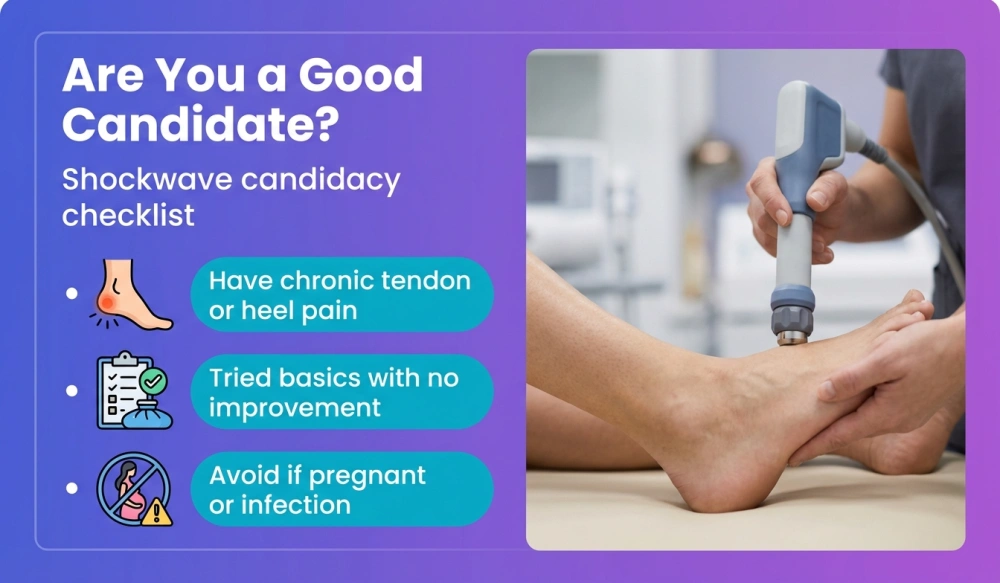
ESWT is generally well tolerated. Temporary soreness, redness, or mild bruising at the treatment site are the most common short term effects. Guidance advises avoiding use over areas with local malignancy, active infection, or open wounds, and to take caution with bleeding disorders, anticoagulant use, or near sensitive structures like the lungs. Pregnancy is commonly listed as a reason to defer treatment. Safe use requires proper training and adherence to device guidelines. We will screen carefully and coordinate with your other clinicians as needed before proceeding [2] [5] [7].
Certain devices for musculoskeletal use have been cleared or approved by the United States Food and Drug Administration for specific indications. Device status and labeling are public and can be reviewed, and our clinic follows manufacturer instructions as well as state scope of practice requirements [8] [10].
What should you expect during and after a session?
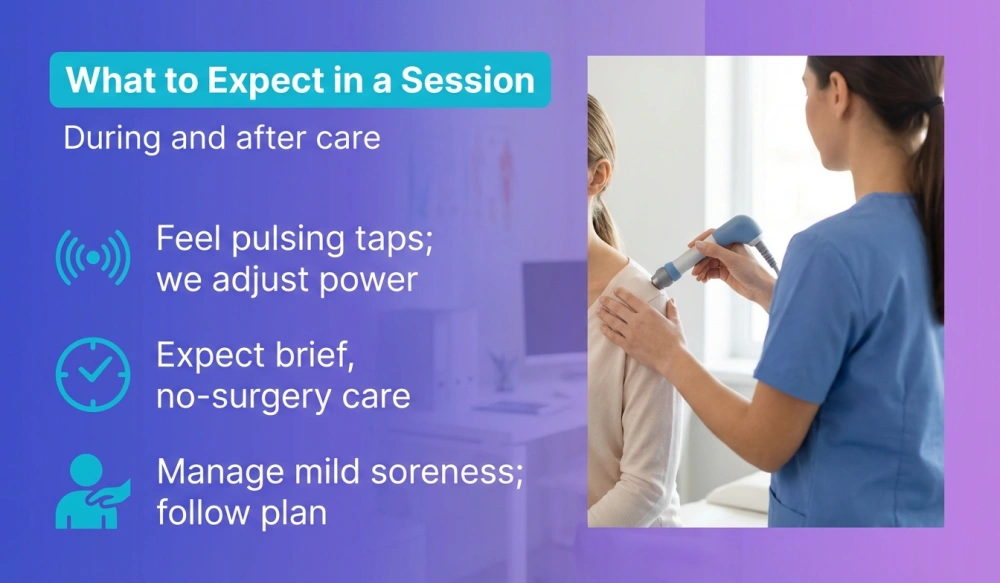
Before your first session we take a thorough history and exam, review prior imaging when available, and confirm that ESWT fits your goals and clinical picture. During a treatment your provider applies gel to the skin and positions the handpiece over the target area. Settings are adjusted to a tolerable level while still delivering a meaningful stimulus. You may feel pulsing or tapping sensations that vary in intensity across the session. Most visits last minutes rather than hours. Afterward it is common to feel some temporary soreness for a day or two, which can be managed with simple measures as discussed during your visit. You will receive clear instructions about activity levels between sessions and how to resume exercises in a graded way [5] [6].
How many sessions are typical and when might improvements start?
Plans are individualized, but many cases involve a series of sessions spaced about one week apart, commonly in a range of three to six visits. Some people notice early changes in pain sensitivity or movement ease, while others require more time and rehabilitation to see meaningful change. We set checkpoints to reassess progress. If you are not seeing benefits that justify continued care, we will discuss options and collaborate on next steps, which may include imaging, referral, or alternate strategies. Shared decision making guides each stage of care [5] [6].
Who is a good candidate and who should avoid this therapy?
You may be a candidate if you have a clearly defined tendon or fascia condition such as plantar fasciitis, Achilles tendinopathy, or tennis elbow that has persisted despite consistent first line care. Good candidates understand that ESWT is part of a plan that includes activity and loading changes and that responses vary. If you are pregnant, have a bleeding disorder, have an active infection, or have a tumor in the target area, ESWT would not be advised. Use near certain implants or medical devices requires careful consideration. We will review your medical history and answer your questions before beginning [2] [5] [7].
People often ask about age limits. There is no single age cutoff, but growth plates in children and adolescents require special caution and are typically avoided. For older adults, screening for bone quality and general health guides decisions about loading and expectations [7].
How does shockwave therapy fit with chiropractic care and rehabilitation?
Chiropractic care emphasizes restoring function and comfort through conservative methods. ESWT can complement hands on care and exercise by helping reduce pain sensitivity in a focal area so that you can engage more comfortably in progressive loading, mobility work, and daily activity. Within our clinic we match the modality to the person, not the other way around. That means we may start with gentle loading and education and add ESWT when it meaningfully supports your progress toward goals like walking the neighborhood without heel pain or returning to doubles tennis without elbow flare ups [3] [11].
We also pay close attention to the way symptoms fit into your routine. For example, plantar fasciitis treatment may include guidance about morning steps, footwear, and load management at work. Achilles tendinitis therapy may shift week to week based on running volume and calf strength testing. With each step we discuss what the research and clinical guidance suggest while keeping the plan practical for your schedule and preferences [3] [12].
How does shockwave therapy compare to injections, surgery, or other options?
It is helpful to understand where ESWT fits among other treatments. In many guidelines, ESWT is considered after initial measures such as load management, activity changes, and exercise have been tried consistently. Compared with steroid injections, ESWT does not carry risks like tissue weakening at the injection site, although injections may be considered for specific cases. Surgery is reserved for a small portion of people with severe, long standing symptoms who do not respond to comprehensive conservative care. Other modalities like manual therapy, taping, and bracing may be used as supportive tools. We will discuss the pros and cons of each option in your context and coordinate with your medical team as needed [1] [3] [4] [11] [12].
What should you know about cost and insurance in California?
Coverage for ESWT varies by insurer and plan. Some policies consider ESWT for certain diagnoses after a period of conservative care, while others consider it an exclusion. We provide clear explanations of fees and can supply documentation so that you can check benefits with your plan. Because ESWT is delivered in a clinic and does not require facility or anesthesia costs, many people find it a practical option to try before considering more invasive procedures. We will discuss your goals, your budget, and the expected number of sessions before starting so you can make an informed choice.
What regulations and professional standards apply in California?
In California, chiropractors practice under the oversight of the California Board of Chiropractic Examiners. The Board outlines scope of practice and professional standards for services provided in a chiropractic clinic. Our providers follow these requirements and maintain appropriate training for the modalities we use. We also follow device manufacturer instructions and Federal guidance regarding the intended uses for devices that have been cleared or approved for specific indications. Your privacy is protected under federal law through the Health Insurance Portability and Accountability Act privacy rule and our clinic policies reflect those standards [10] [8] [9].
When should you consider seeking evaluation in Santa Ana?
Consider an evaluation if you have tendon or fascia pain that persists beyond several weeks despite rest, activity adjustments, and simple exercises. If your symptoms limit walking, work, sport, or sleep, it is worth getting a professional assessment so that you can understand the diagnosis and options. People often reach out to discuss plantar fasciitis treatment, tennis elbow treatment, Achilles tendinitis therapy, or calcific shoulder tendinopathy that has not responded to first line measures. If you have questions about ESWT Santa Ana services, we are glad to explain the process and how it might fit your plan. The goal is to help you make a clear, informed decision that aligns with your needs and timeline [1] [2] [3].
For those looking across the region, Shockwave Treatment Orange County searches will return many options. We encourage you to look for licensed providers who use evidence informed protocols, explain benefits and risks clearly, and integrate treatment into an active rehabilitation plan. If a clinic offers quick fixes without a plan for progressive loading or does not screen for contraindications, it is reasonable to ask more questions before proceeding [2] [7].
Why choose OneAndOnlyChiro for shockwave therapy in Santa Ana?
At OneAndOnlyChiro, we offer Extracorporeal Shockwave Therapy as part of a comprehensive approach to noninvasive musculoskeletal care. Our clinic serves Santa Ana and the broader Orange County community. We provide clear evaluations, explain findings in plain language, and collaborate with you on practical next steps. When appropriate, we use focused shockwave therapy or radial pressure wave therapy to support soft tissue healing and reduce pain sensitivity so you can engage in active rehab with confidence.
Here is how our approach supports you from start to finish:
- Tailored plans We build each plan around your diagnosis, goals, and schedule. A plantar fasciitis plan may emphasize morning routines and gradual walking goals, while a lateral elbow plan may target grip tolerance for work and play.
- Evidence informed choices We align treatment with recognized guidance and device instructions and we monitor your response at each step to decide whether to continue, change course, or refer.
- Integrated rehab Shockwave sessions pair with activity coaching and progressive loading so that gains in comfort become gains in function.
- Clear communication You receive concise instructions about what to expect during and after sessions, how to adjust activity, and when to follow up.
- Modern tools We use secure digital outcome tracking to measure changes that matter, such as pain with first steps in the morning or tolerance for time on feet at work.
- Collaborative care With your permission, we coordinate with your physician, coach, or physical therapist to keep care aligned and efficient.
- Local access Our Santa Ana location makes it easier to complete a short series of sessions without long travel time, which supports consistency.
Our providers have experience with chronic pain management and sports injury rehabilitation across a wide range of ages and activity levels. Clients appreciate a steady, honest approach that puts your goals first and avoids over treatment. You connect directly with qualified professionals and can ask questions at any time. If you are exploring Shockwave Pain Relief and want to understand whether it fits your situation, call us at (949) 800 8525 and we will help you chart a clear path forward.
We also understand that decisions include cost and time. We will outline expected session counts, discuss how we will measure progress, and explain how we will decide together whether to continue or adjust your plan. For those searching specifically for care in our area, our team is ready to walk you through options for Shockwave Therapy Santa Ana and to explain how we blend ESWT with chiropractic care, movement coaching, and lifestyle support.
What questions do people often ask about shockwave therapy?
Will I feel pain during treatment and how intense is it?
You will feel pulsing sensations at the treatment site that can range from mild to moderately intense. We adjust settings during the visit to match your tolerance. The aim is a strong but manageable stimulus. Mild soreness after treatment is common and typically settles within a day or two [5] [6].
Can I exercise between sessions or should I rest completely?
Most plans include continued activity with adjustments to keep symptoms manageable. For tendon problems, progressive loading is key, and we will guide you on exercises to continue and which to pause temporarily. Over time, activity usually increases in a graded way that fits your goals [11] [12].
How soon could I notice changes in pain or function?
Some people notice early changes within a few sessions, while others need more time and a focus on exercise to see meaningful gains. We set check points to review progress and update the plan. If progress is limited, we will talk through options, which may include imaging or referral [5] [6].
Is shockwave therapy safe around implants or pacemakers?
Use near certain implants or medical devices requires caution and case by case evaluation. We will review your medical history and coordinate with your physician as appropriate to ensure safe choices. We avoid applying energy directly over sensitive structures and follow device guidelines closely [7] [8].
Does shockwave therapy replace other treatments like stretching or strengthening?
No. ESWT is typically an adjunct that may help reduce pain sensitivity and support participation in a progressive rehab plan. Stretching, strengthening, and load management remain essential for most tendon and fascia problems. We will show you how the pieces fit together in a practical weekly plan [3] [11] [12].
Is there any downtime after a session?
There is usually no downtime beyond temporary soreness. We often suggest avoiding very intense activity for one to two days after treatment, then resuming your plan as directed. This helps balance tissue stimulus with recovery [5] [6].
How does ESWT relate to focused and radial devices?
Focused devices concentrate energy at a specific depth and are often selected for deeper structures or calcific targets. Radial pressure devices spread energy more broadly near the surface and are commonly used for muscle and superficial tendon areas. We will choose the approach that matches your diagnosis and tolerance during a trial session [5] [6] [7].
Can ESWT be used alongside manual therapy or spinal adjustments?
Yes. We often pair ESWT with manual therapy techniques and chiropractic adjustments when indicated, along with exercise and education. The combination seeks to reduce pain sensitivity and improve movement control so you can build capacity safely and steadily.
How do you protect my privacy and medical information?
Your health information is protected by clinic policy and federal privacy rules. We use secure systems to store and share information and we only disclose information with your consent or as permitted by law [9].
Where do you provide shockwave therapy and how can I get started?
We provide care in Santa Ana, CA and serve the surrounding Orange County community. If you are ready to discuss Extracorporeal Shockwave Therapy or wish to learn whether it fits your situation, call (949) 800 8525. We will answer your questions, review your goals, and help you decide on a plan that makes sense for you. Many people begin with a simple evaluation and same day first session if appropriate.
References
- Extracorporeal shockwave therapy for refractory plantar fasciitis – NICE
- Extracorporeal shockwave therapy for calcific tendinitis of the shoulder – NICE
- Plantar Fasciitis – OrthoInfo AAOS
- Plantar fasciitis treatment – Mayo Clinic
- Extracorporeal Shock Wave Therapy ESWT – Cleveland Clinic
- Extracorporeal Shock Wave Therapy ESWT – UCSF Health
- International Society for Medical Shockwave Treatment ISMST – ISMST
- PMA P990086 OssaTron – FDA
- HIPAA Privacy Rule – HHS
- Scope of Practice – California Board of Chiropractic Examiners
- Tennis Elbow Lateral Epicondylitis – OrthoInfo AAOS
- Achilles Tendinitis – OrthoInfo AAOS
- Calcific Tendinitis – OrthoInfo AAOS