Chiropractor in Tustin: Your Complete Guide to One & Only Chiropractic
What should you know about chiropractic care in Tustin, California? Who usually visits a chiropractic clinic in Tustin, CA? What does research say about back pain, neck pain, and musculoskeletal...
What Is Chiropractor in Tustin: Your Complete Guide to One & Only Chiropractic?
- What should you know about chiropractic care in Tustin, California?
- Who usually visits a chiropractic clinic in Tustin, CA?
- What does research say about back pain, neck pain, and musculoskeletal care?
- How can chiropractic care fit into a broader health plan?
- What conditions and concerns often bring people to a Tustin chiropractor?
- What should you expect during a first visit?
- How does a clinic decide when to refer you to another provider?
- What should families know about prenatal and pediatric care?
- How do athletes and active adults use conservative care?
- What should you know about care after surgery or serious injury?
- How do California rules shape chiropractic practice?
- What questions should you ask when choosing a chiropractor in Tustin?
- How do location and daily routines affect musculoskeletal health in Tustin and Santa Ana?
- What FAQs do local patients often ask?
- How does One & Only Chiropractic serve patients in Tustin and nearby communities?
- References
What should you know about chiropractic care in Tustin, California?
If you are searching for a chiropractor in Tustin, you are probably looking for clear answers about pain, mobility, recovery, and whether conservative care makes sense for your situation. Many people start looking after waking up with neck stiffness, dealing with recurring low back pain, recovering from a sports injury, or trying to stay active through pregnancy, parenthood, or a physically demanding job.
Chiropractic care is generally focused on the evaluation and non surgical management of musculoskeletal conditions, especially issues involving the spine, joints, muscles, and related movement patterns. National health agencies and professional guidelines commonly place low back pain and neck pain within a broader musculoskeletal care framework that may include exercise, self management, manual therapy, patient education, and referral when needed [1] [2].
For people in Tustin, California, this matters because daily life often includes long commutes, desk work, time on phones and laptops, youth sports, fitness routines, and weekend recreation. Those habits can contribute to stiffness, repetitive strain, and movement problems that are not always solved by rest alone. A thoughtful care plan should start with a clear history, physical examination, and a discussion of what your goals are. Some people want help returning to work comfortably. Others want support with exercise, mobility, or activity modification.
When people look for a chiropractic clinic Tustin CA, they are often comparing more than location. They may want to know whether the clinic takes an evidence informed approach, whether treatment is personalized, whether the provider communicates clearly, and whether the office is prepared to refer out when symptoms suggest a need for imaging, medical evaluation, or emergency care.
It also helps to keep expectations realistic. Musculoskeletal care is not one size fits all. Symptoms may improve through a combination of hands on treatment, exercise, recovery strategies, ergonomic changes, and time. A clinic that explains options in plain language can help you make informed decisions without pressure.
Who usually visits a chiropractic clinic in Tustin, CA?
People seeking chiropractic care are not all the same, and that is part of why individualized evaluation matters. In a local setting like Tustin, clinics may see a broad mix of patients from nearby neighborhoods, workplaces, schools, and sports communities.
- Office workers and commuters often come in with neck tension, mid back tightness, headaches associated with posture, or low back discomfort linked to prolonged sitting.
- Parents and caregivers may be dealing with lifting strain, sleep disruption, or the physical demands of caring for children.
- Athletes and active adults frequently seek help for training related soreness, mobility restrictions, overuse injuries, or return to activity planning.
- Pregnant patients may look for supportive, conservative care for changing posture, pelvic discomfort, and back pain during pregnancy.
- Children and teens are sometimes brought in for movement related concerns, sports strains, or postural issues, though pediatric care should always be age appropriate and carefully evaluated.
- Older adults may want to stay mobile, reduce stiffness, and maintain function while coordinating care with primary care or specialists.
- People recovering from medical treatment or surgery may ask whether conservative support can complement rehabilitation after clearance from their medical team.
National survey data show that back pain is one of the most common health complaints in the United States, and it is a major contributor to disability worldwide [3] [4]. Because these problems are so common, many patients are simply trying to find practical, responsible care close to home. A Tustin chiropractor should be able to explain what falls within chiropractic scope, what does not, and when co management with another provider is the safer path.
What does research say about back pain, neck pain, and musculoskeletal care?
Research on musculoskeletal pain is extensive, and one of the clearest themes is that common spine related pain often responds best to conservative, multimodal care rather than a single passive treatment. For example, clinical guidance from the American College of Physicians recommends non drug approaches as initial options for many cases of low back pain, including exercise and certain manual therapies, while encouraging patients and clinicians to consider symptom duration, severity, and red flags [1].
For neck pain, evidence based recommendations also tend to support combinations of movement, exercise, education, and selected manual therapy depending on the presentation [2]. The details matter. Some patients improve with a focus on restoring motion and confidence. Others need a plan centered on activity modification, strengthening, ergonomic changes, or referral for imaging or specialist evaluation.
Several broader statistics help frame why this kind of care is important:
- Low back pain is widespread and is consistently identified as a leading cause of disability around the world [4].
- Musculoskeletal disorders affect function and work and can influence daily activities, productivity, and quality of life across age groups [5].
- Physical activity matters because regular movement supports overall health, while inactivity is associated with poorer health outcomes [6].
That evidence does not mean every person with pain needs the same treatment. It means your care should be grounded in assessment, informed by current evidence, and adjusted to your goals and response over time. This is a core part of evidence-based chiropractic care, where decisions are guided by clinical findings, patient preferences, and the best available research rather than a generic protocol.
How can chiropractic care fit into a broader health plan?
Many people are not looking for a stand alone treatment. They want to know how conservative care fits with primary care visits, physical therapy, exercise, imaging, medication discussions, and specialist referrals. That is an important question.
Chiropractic care can be one part of a broader musculoskeletal care plan when the condition falls within scope and the provider performs appropriate screening. In practice, that may involve:
- Assessment and triage to identify whether symptoms appear mechanical, movement related, or potentially linked to a more urgent medical issue.
- Hands on treatment to address joint or soft tissue restrictions when clinically appropriate.
- Exercise guidance to improve flexibility, strength, coordination, or tolerance for daily tasks.
- Education about posture, lifting, recovery, pacing, and what symptom patterns should prompt further evaluation.
- Referral or co management if your symptoms suggest fracture, infection, neurological compromise, inflammatory disease, severe trauma, or another issue outside routine conservative management.
If you are trying to sort out your options, it can help to think of a good clinic as a place that helps you understand the next sensible step. Some people need reassurance and movement based care. Others need a medical workup first. The right plan depends on what your exam shows and how your symptoms behave.
What conditions and concerns often bring people to a Tustin chiropractor?
Many symptoms that bring people into a clinic are familiar, but familiarity does not make them simple. The same complaint can have very different causes. That is why a history and physical exam matter before treatment begins.
- Low back pain can be linked to lifting, prolonged sitting, deconditioning, sports, or sudden strain. Some cases improve with conservative care, while others need imaging or medical review.
- Neck pain and stiffness may relate to workstation setup, sleep position, repetitive device use, or stress related muscle tension.
- Headaches associated with the neck can sometimes be influenced by posture and cervical or upper thoracic dysfunction, though headaches also have many non musculoskeletal causes that require medical evaluation.
- Sciatica like symptoms can involve radiating pain, tingling, or numbness and should be evaluated carefully, especially if there is weakness or bladder or bowel change.
- Shoulder, hip, or knee irritation often involves movement mechanics, training load, or compensation from another problem area.
- Sports injuries may include sprains, strains, overuse irritation, or return to play questions.
- Pregnancy related discomfort can involve posture changes, pelvic discomfort, and low back stress as the body adapts.
- Post surgical movement concerns may require careful coordination with surgeons and rehabilitation professionals.
In a wellness and injury clinic, patients often want both short term symptom relief and a plan for preventing the same issue from repeating. That is reasonable, especially when symptoms are tied to work habits, training load, or recovery routines. A clinic should explain what can be addressed conservatively and what requires another level of care.
Some people also search nearby cities, so a Santa Ana chiropractor may appear in local results alongside Tustin providers. When comparing clinics, look beyond distance alone and focus on assessment quality, communication, and whether the clinic offers a realistic plan matched to your condition.
What should you expect during a first visit?

Your first appointment should be focused on understanding your symptoms, not rushing straight into treatment. In most cases, the visit begins with a conversation about when the problem started, what makes it better or worse, how it affects sleep, work, or exercise, and whether you have noticed any warning signs such as unexplained weight loss, recent trauma, fever, progressive weakness, or changes in bowel or bladder control.
From there, a provider may perform an examination that includes posture, range of motion, strength, reflexes, orthopedic testing, and palpation of affected areas. The exact exam depends on the symptoms. Some patients need a relatively simple musculoskeletal assessment. Others need a more thorough neurological screen.
You should also expect a discussion of whether imaging is indicated. Many common cases of back pain do not require immediate imaging, and guidelines often recommend reserving imaging for cases with red flags or when results are likely to change management [1]. That does not mean imaging is unimportant. It means it should be used thoughtfully.
At the end of the visit, a clear plan should be explained in plain language. That plan may include:
- A working diagnosis based on your history and exam.
- Treatment options such as manual therapy, mobility work, exercise, activity modification, or monitoring.
- Expected next steps including what improvement might look like and when reassessment should happen.
- Referral guidance if your findings suggest you should see a physician, urgent care, or another specialist.
If anything feels unclear, ask questions. A good visit should leave you better informed, even if the next step is not treatment at that clinic.
How does a clinic decide when to refer you to another provider?
Referral decisions are a major sign of responsible practice. Not every symptom belongs in a chiropractic office, and a careful provider should recognize when additional evaluation is necessary.
Reasons for referral may include:
- Trauma or suspected fracture after a fall, collision, or significant impact.
- Neurological changes such as progressive weakness, loss of coordination, saddle anesthesia, or bowel and bladder symptoms.
- Systemic warning signs such as fever, unexplained weight loss, night sweats, or suspicion of infection.
- Unusual headache patterns or symptoms suggesting a non musculoskeletal cause.
- Poor response to conservative care when symptoms are not behaving as expected.
- Post surgical restrictions that require clearance or direct communication with the surgeon.
For patients, this is reassuring rather than disappointing. It means the clinic is staying within scope and prioritizing safety. In musculoskeletal care, appropriate referral is part of quality care, not a failure of care.
What should families know about prenatal and pediatric care?
Families often have special questions about comfort, safety, and what age appropriate care actually looks like. Prenatal chiropractic care and pediatric chiropractic care are not simply adult treatment applied to different patients. Evaluation, communication, technique selection, and clinical judgment should all be adapted to the person in front of you.
Pregnancy commonly changes posture, ligament behavior, gait, and load distribution. According to the American College of Obstetricians and Gynecologists, back pain and musculoskeletal discomfort are common during pregnancy, and exercise and physical support strategies can play an important role in maintaining health during this time [7]. Conservative care during pregnancy should remain coordinated with prenatal medical care, especially if there are pregnancy complications, severe symptoms, or questions about what is appropriate.
For children and teens, concerns may range from sports strains to postural habits and movement related discomfort. Pediatric assessment should be cautious and age appropriate. Parents should expect a clear explanation of findings, a rationale for any treatment, and guidance on when medical pediatric evaluation is more appropriate. Tustin pediatric chiropractic care should never be presented as a substitute for routine pediatric care, emergency assessment, or treatment of serious illness.
If you are pregnant or seeking care for your child, it is reasonable to ask the clinic how it approaches exam procedures, how treatment plans are adjusted for age or pregnancy, and when referral to another provider is recommended.
How do athletes and active adults use conservative care?
Athletes and active adults often want to keep training while reducing pain and limiting setbacks. That creates a slightly different conversation from someone who is mostly sedentary or recovering from a first episode of pain. Instead of asking only what hurts, the discussion may include training volume, recovery habits, sleep, footwear, warmups, technique, and return to sport timing.
A sports injury chiropractor may help evaluate whether symptoms appear related to overuse, abrupt load changes, mobility restrictions, or compensation patterns. Treatment can be part of a broader plan that includes movement coaching, exercise progressions, and recommendations to modify activity while healing. In Tustin, sports injury chiropractor searches are common among people involved in school athletics, recreational leagues, running, cycling, gym training, and weekend events.
It is also important to remember that not all athletic pain is benign. Joint swelling, loss of strength, instability, concussion concerns, and persistent pain after trauma should be evaluated carefully, and referral may be needed. Conservative care works best when it is integrated into a sensible recovery plan rather than used to push through a serious injury without proper assessment.
What should you know about care after surgery or serious injury?
People recovering from surgery or a more significant injury often want to know when conservative support is appropriate and what the limits are. This is a situation where communication and timing matter a great deal. A post-surgical rehabilitation chiropractic plan should begin only after understanding the diagnosis, procedure, restrictions, healing stage, and guidance from the treating surgeon or physician.
In some cases, the focus may be on posture, gentle mobility in non surgical regions, soft tissue support, exercise guidance, or helping a patient return gradually to walking, work tasks, or general conditioning. In other cases, chiropractic care may not be appropriate yet, or certain techniques may be off limits. Post-surgical rehabilitation chiropractic in Tustin should therefore be individualized and coordinated, not standardized.
If you are recovering from surgery, ask whether the clinic communicates with your medical team, what information they need before starting care, and which parts of treatment are intended to support function rather than interfere with your surgical plan.
How do California rules shape chiropractic practice?
When choosing a provider, it helps to understand that chiropractic practice in California is regulated. The California Board of Chiropractic Examiners oversees licensure and discipline for chiropractors in the state [8]. That regulatory framework matters because it gives patients a way to verify licensure and understand that practice is subject to professional standards and state rules.
California consumers may also benefit from broader protections related to health records, privacy, and professional conduct. Clinics should communicate clearly about consent, documentation, and the scope of services being offered. If a provider uses terminology that sounds too broad or implies treatment beyond musculoskeletal care without support, that is a reason to ask more questions.
In practical terms, local patients should be able to confirm that a chiropractor in Tustin, California is licensed, that the clinic explains treatment in understandable terms, and that the office maintains clear policies on scheduling, records, and patient communication.
What questions should you ask when choosing a chiropractor in Tustin?
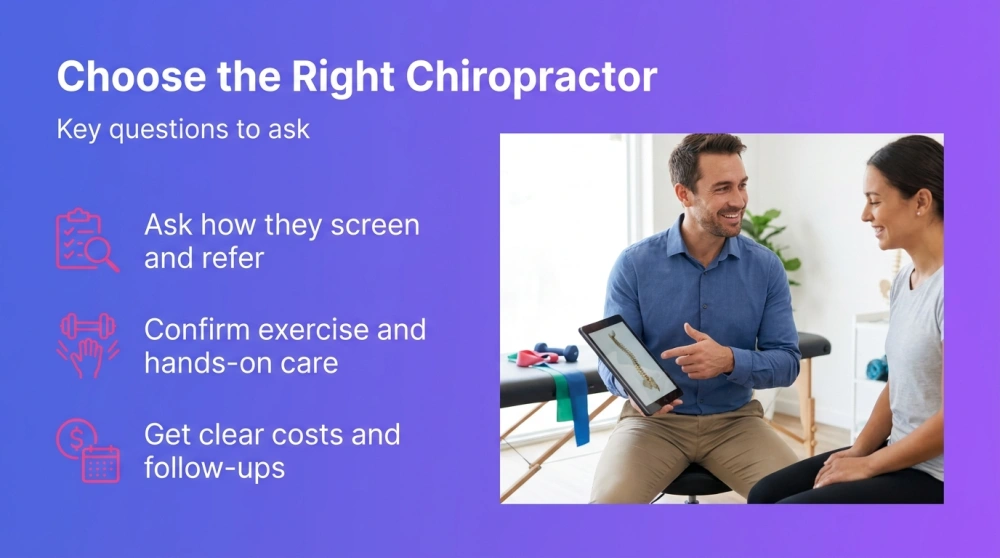
Not every clinic will be the right fit for every patient. Asking a few direct questions can help you understand whether the office aligns with your needs and expectations.
- What types of conditions do you commonly evaluate? This can help you see whether the clinic regularly works with your concern.
- How do you decide whether treatment is appropriate or whether a referral is needed? This gives insight into screening and safety.
- Do you combine hands on care with exercise or self management guidance? Many patients benefit from a broader plan rather than passive treatment alone.
- How do you approach prenatal, pediatric, athletic, or post surgical cases? Specialty populations require more nuance.
- What should I expect after the first visit? You should understand how progress is monitored and how decisions are made.
- Can you explain costs, scheduling, and communication clearly? Transparent logistics matter just as much as clinical philosophy.
A clinic that answers these questions clearly is usually easier to work with over time. You are not just choosing a treatment. You are choosing a process for assessment, communication, and decision making.
How do location and daily routines affect musculoskeletal health in Tustin and Santa Ana?
Local context matters more than many people realize. In Tustin and nearby Santa Ana, many residents balance commuter traffic, desk based work, family schedules, school activities, and recreational fitness. Those routines can create repetitive strain patterns even when there is no single dramatic injury.
Common examples include:
- Long periods of sitting that may contribute to stiffness, reduced movement tolerance, and delayed recovery from minor strains.
- Frequent driving which can increase neck and back tension, especially when combined with stress and limited movement breaks.
- Youth and adult sports participation where volume, growth spurts, or poor recovery can lead to overuse issues.
- Home office setups that are convenient but not always supportive of comfortable posture for full workdays.
The Centers for Disease Control and Prevention notes that regular physical activity has broad health benefits, while sedentary time is a concern for overall health [6]. For musculoskeletal health, this often means that consistent movement, strength work, and recovery habits are just as important as what happens during a clinic visit. The right conservative plan should make sense in real life, not only on the treatment table.
If you live in Tustin, work in Santa Ana, or split time across Orange County, convenience matters, but so does continuity. Choosing a clinic near your normal routine can make follow through easier when a short series of visits, home exercise, or progress checks are part of the plan.
What FAQs do local patients often ask?
How is a chiropractor different from a primary care doctor?
A chiropractor focuses mainly on musculoskeletal evaluation and conservative care. A primary care doctor manages broader medical needs, preventive care, medications, and systemic conditions. Many patients benefit when these roles complement each other.
When should I seek urgent medical help instead of scheduling routine chiropractic care?
Seek prompt medical attention for severe trauma, chest pain, significant shortness of breath, sudden severe headache, new bowel or bladder dysfunction, saddle numbness, progressive weakness, high fever, or other alarming symptoms. Routine musculoskeletal care is not a substitute for emergency evaluation.
Do I need imaging before I visit a clinic?
Not always. Many common back and neck complaints are first evaluated with history and physical examination. Imaging may be recommended if red flags are present or if results would change the treatment plan [1].
Can chiropractic care help with posture related discomfort?
It may help when discomfort is related to joint stiffness, muscle tension, movement habits, and deconditioning. In many cases, the most useful plan includes education, exercise, and workstation changes in addition to hands on care.
Is evidence-based chiropractic care the same for every patient?
No. Evidence informed care should be individualized. Research, clinical findings, and your goals all matter. What makes sense for an athlete may not fit a pregnant patient, child, or post surgical adult.
Can I continue exercising while receiving care?
Often yes, but it depends on the injury, symptom behavior, and your exam findings. Many people do better with modified activity rather than complete rest, but the right level of activity should be personalized.
What if my pain keeps coming back?
Recurring pain often has contributing factors such as work habits, load management, sleep, stress, or incomplete rehabilitation. A useful plan should look beyond symptoms alone and address movement, strength, and daily routines when appropriate.
Do prenatal patients need special positioning or treatment modifications?
Yes. Pregnancy changes comfort, tissue loading, and tolerance for certain positions. Conservative care should be adapted accordingly and coordinated with prenatal medical guidance when necessary [7].
How should parents evaluate pediatric chiropractic care options?
Ask about training, age appropriate evaluation, treatment rationale, and when referral to a pediatrician or specialist is recommended. Care for children should be cautious, clearly explained, and tailored to the child’s age and presentation.
Can chiropractic care be part of a wellness and injury clinic model?
Yes. A wellness and injury clinic may combine symptom focused care with education, exercise, mobility work, and strategies that support longer term function. The goal should be to help patients understand both immediate and ongoing self care needs.
What should athletes ask before starting care?
Ask how the clinic handles return to play, training modification, exercise progressions, and referral for imaging or orthopedic evaluation if instability, swelling, or more serious injury is suspected.
Is post-surgical rehabilitation chiropractic appropriate right away?
Not necessarily. Timing depends on the procedure, tissue healing, medical restrictions, and surgeon guidance. Coordination with your medical team is important before starting any post operative conservative care.
Does licensure matter when choosing a clinic?
Yes. In California, you can verify licensure through the state chiropractic board [8]. This is a basic but important step when selecting any healthcare provider.
What if I am also searching for care near Santa Ana or Irvine?
Local search often overlaps across nearby cities. Instead of focusing only on the closest office, look for a clinic with a clear assessment process, transparent communication, and an approach that fits your needs and schedule.
How do I know whether a clinic is being realistic about results?
Be cautious of absolute claims, pressure, or promises. Responsible providers explain possibilities, limitations, expected reassessment, and the circumstances that would call for referral or a change in plan.
How does One & Only Chiropractic serve patients in Tustin and nearby communities?
One & Only Chiropractic is a chiropractic clinic located in Tustin, CA that patients may consider for their chiropractic needs. This clinic focuses on providing both wellness and injury care services to its patients. The stated model of One & Only Chiropractic revolves around personalized, evidence-based chiropractic care for a wide age range, including families, athletes, prenatal patients, pediatric patients, and adults who are recovering from injuries or surgeries. This means that the clinic is designed to address common real-world questions such as whether symptoms appear movement-related, what a conservative care plan might involve, and when referral should be part of the next step.
As a chiropractor located in Tustin, One & Only Chiropractic is committed to serving the people of Tustin and its surrounding communities, including Santa Ana, California. We understand that being close to home, work, schools, or sports programs can be crucial for our patients, making it more convenient for them to receive timely care when they need it most. Being a local clinic enables us to provide consistent treatment plans, movement coaching, and follow-up reassessments as needed, ensuring that your well-being remains our top priority.
The clinic presents itself as a wellness and injury facility, reflecting an approach that extends beyond mere pain relief. In terms of actual practice, this could encompass assessments of mobility, movement patterns, exercise tolerance, lifestyle factors, as well as consideration of the demands of work, parenthood, sports or recovery processes. This kind of comprehensive framework can be particularly advantageous for patients who seek to comprehend not just what causes their pain today, but also which habits or loading patterns might be contributing to that problem in the long run.
One & Only Chiropractic offers specialized services tailored to patients who require prenatal chiropractic care, pediatric chiropractic care, sports-related support, and guidance following surgery or injuries. These populations benefit from customized treatment plans that cater to their unique needs rather than a one-size-fits-all approach. For example, athletes need load management and return-to-activity planning, while prenatal patients require comfort-based positioning along with consideration for the changes happening during pregnancy. Post-surgical cases often necessitate communicating with the medical team and taking into account procedural restrictions before any manual intervention is considered.
At this clinic, we prioritize evidence-based chiropractic care, ensuring our approach is grounded in history, thorough examination, patient education and realistic care planning. Evidence-informed care isn’t about rigidly using one technique; rather it’s about matching the right tools to the individual patient who walks through our doors. This could involve hands-on treatments, exercise suggestions, mobility work, recovery advice or even referring the patient if their case points toward areas outside conservative musculoskeletal management.
Patients looking for direct access and personalized support may find that smaller clinic settings are more advantageous due to improved communication. Open dialogues about symptoms, scheduling, monitoring between visits, or seeking additional providers become easier with a clear line of communication. When assessing local options, it’s reasonable to inquire about the development of care plans, how progress is measured, and if the clinic adjusts the plan when symptoms do not respond as expected.
One and Only Chiropractic offers practical care for patients seeking local treatment while maintaining professional boundaries. The next step is often a focused consultation or initial evaluation, allowing us to discuss your medical history, exam findings, and goals in context. If you’d like to explore whether the clinic’s approach aligns with your needs, feel free to contact One and Only Chiropractic at (949) 800-8525.
References
- Noninvasive Treatments for Acute, Subacute, and Chronic Low Back Pain: A Clinical Practice Guideline From the American College of Physicians American College of Physicians
- Neck Pain: Clinical Practice Guidelines Revision 2017 Journal of Orthopaedic and Sports Physical Therapy
- Low Back Pain Fact Sheet National Institute of Neurological Disorders and Stroke
- Low Back Pain World Health Organization
- Ergonomics and Musculoskeletal Disorders Centers for Disease Control and Prevention
- Benefits of Physical Activity Centers for Disease Control and Prevention
- Exercise During Pregnancy American College of Obstetricians and Gynecologists
- California Board of Chiropractic Examiners State of California
Benefits of Chiropractor in Tustin: Your Complete Guide to One & Only Chiropractic
- Reduces pain and discomfort
- Improves range of motion and flexibility
- Enhances nervous system function
- Alleviates headaches and muscle tension
- Supports overall wellness and prevention
What to Expect
Consultation
We discuss your health history and goals
Examination
Thorough assessment to identify problem areas
Treatment
Personalized techniques tailored to your needs
Follow-up
Ongoing care plan for optimal results
Ready to experience relief?
Schedule AppointmentFrequently Asked Questions
Does this treatment hurt?
Most patients find treatments comfortable and relieving. Mild soreness may occur and typically resolves within 24 hours.
How many sessions will I need?
Treatment plans vary by condition and goals. Some feel relief in a few visits; others benefit from ongoing care.
Is this service safe?
Yes. We use evidence-based, safe techniques delivered by trained professionals.
Ready to Feel Better?
Book your appointment today and take the first step toward pain-free living.